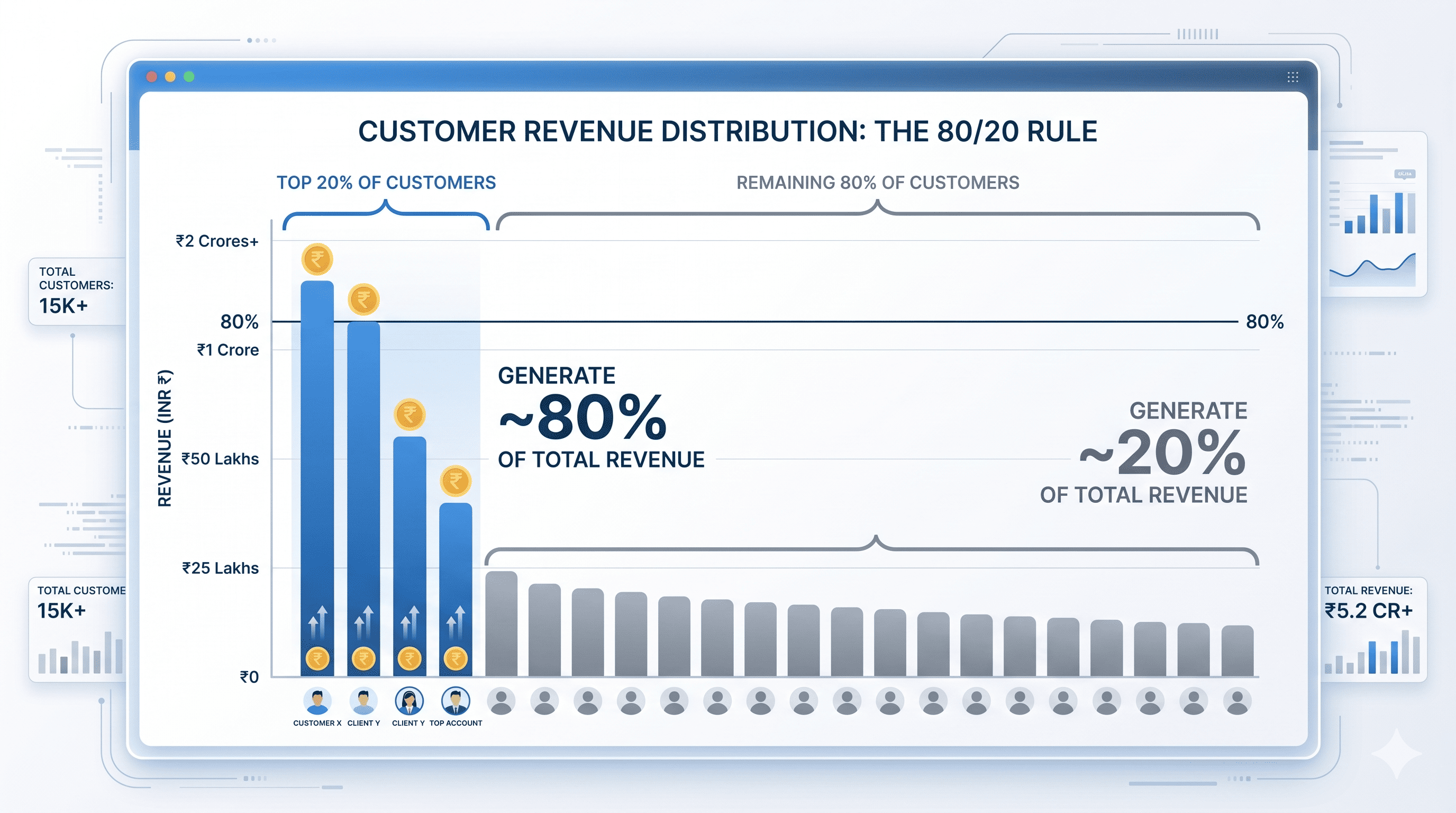
Open your Stripe dashboard or Excel export right now.
Sort customers by total money spent. You'll probably see something uncomfortable: a small cluster of people quietly paying for almost everything.
This isn't a fluke. It's the Pareto principle in action — the observation that in many systems, roughly 80% of results come from 20% of causes. In business, that often shows up as 20% of customers generating about 80% of revenue or profit.
Let's make that painfully concrete.
A Simple Example: 100 Customers, ₹10,00,000 Revenue
Imagine your business has:
- 100 paying customers
- Total revenue this year: ₹10,00,000
Now sort them by revenue contribution from highest to lowest. A very common pattern looks like this:
- Top 20 customers: ₹8,00,000
- Remaining 80 customers: ₹2,00,000
That means:
- Each top 20 customer is worth ₹40,000 on average
- Each of the other 80 is worth just ₹2,500 on average
The vital few are 16x more valuable than the trivial many. Lose one of the top 20 and you feel it in your P&L. Lose one of the bottom 80 and you barely notice.
Why This Happens in Real Businesses
This skewed pattern shows up across industries because most things in life are not evenly distributed. People have different:
- Budgets
- Urgencies
- Use cases
- Switching costs
Some become loyal power users who buy everything you release, upgrade plans, and stay for years. Others try you once on a discount, then disappear.
In e-commerce, repeat customers are often nearly 16 times more efficient in revenue than one-time buyers. In B2B, a few anchor clients can pay more than hundreds of small accounts.
What You Should Do With This Information
The 80/20 rule is not a law of physics, but it's a strong signal on where to focus.
1. Identify your top 20% customers by revenue (or profit)
Pull last 12 months' data, sort by total paid, and mark the top slice.
2. Study them obsessively
- Where did they come from?
- What problem do they actually pay you to solve?
- Why did they upgrade or stay?
3. Double down on them
- Create offers, features, or services that make their life 10x easier.
- Give them priority support, early access, or custom options.
- Build referral systems around them.
4. Rethink the bottom 80%
Some will grow into top customers later. Many won't. It might not be worth building your entire roadmap around people who spend little, complain a lot, and churn often.
The point is not to ignore small customers. It's to stop treating every customer as equally important when the math says otherwise.
When the 80/20 Rule Can Mislead You
Reality isn't always exactly 80/20. Sometimes it's 70/30, 60/40, or even more extreme like 90/10. Some industries have a flatter distribution where revenue is more evenly spread.
So don't assume the pattern — measure it.
- Export your customer list with total revenue per customer.
- Make a running total and see what percent of customers account for 50%, 70%, 80% of sales.
- Decide your strategy based on your actual data, not a meme.
Used properly, 80/20 is not a quote for Instagram. It's a ruthless lens: Which few relationships and actions are quietly driving almost everything — and how do I protect and multiply those?
One Action for You This Week
Pick your last 12 months of sales. Find your top 10–20 customers by revenue. Send them each a short, personal email:
"You're one of our most important customers. What's one thing we could do in the next 30 days that would make this 2x more valuable for you?"
Sometimes, the next ₹10,00,000 idea is already sitting inside the 20% who pay your bills.