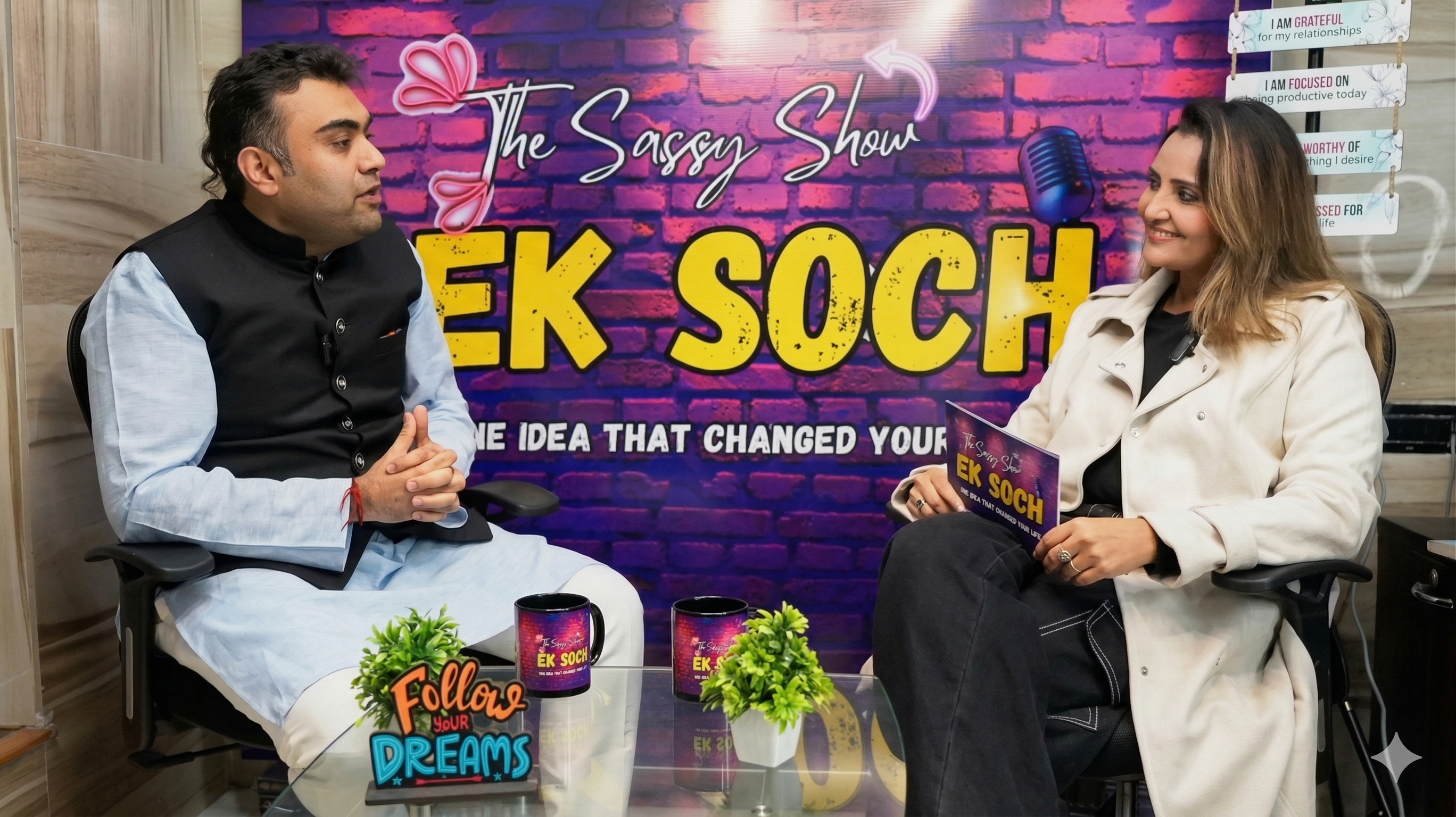
First-generation politician and educationist Nikhil Vyas shares his journey from joining politics at 17 to the U.S. IVLP program — and why every young Indian must be politically aware, on Ek Soch Podcast.
Mumbai: India's median age is twenty-eight. It is one of the youngest nations on earth by population. And yet, Nikhil Vyas argues, the generation that will inherit every infrastructure decision, every policy outcome, and every governance failure currently treats politics as something to be avoided at the dinner table.
In a recent conversation on the Ek Soch Podcast with host Nirale Pandya, Nikhil Vyas — General Secretary of BJP North Mumbai, member of the Mumbai Suburban District Planning Committee, and first-generation politician from a family with a seventy-one-year legacy in education — made a case that is equal parts civic argument and personal story: that political awareness is not optional for young Indians, and that the distance most youth maintain from politics is itself a political choice with consequences.
"He joined politics at seventeen with no family background in it. Today he sits on Mumbai's Suburban District Planning Committee — and his most urgent message is not about power, but about awareness."
A First-Generation Politician from an Education Family
Nikhil Vyas comes from a joint family of thirty-six in Mumbai. There is no political background in his lineage — he is the first. What his family does carry is an educational one: his grandfather founded a school in Kandivali that now serves three thousand students, a legacy stretching back seventy-one years.
The spark that redirected him toward politics came from a single speech — delivered by the late Pramod Mahajan at Prabodhankar Thackeray Hall. Nikhil was seventeen. The speech became, in his telling, the ek soch — the one idea — that set his direction.
He did not come from a family with connections, with party infrastructure already in place, or with the social capital that typically smooths the entry of young people into political organisations. He built his way in from the beginning, which makes his current position — General Secretary of one of Mumbai's most significant BJP units — a product of sustained effort rather than inherited access.
What He Actually Means When He Talks to Youth About Politics
Nikhil is precise about what he is and is not asking of young people when he urges greater political engagement.
He is not saying every young Indian should enter politics. He is saying every young Indian should be politically aware — and that there is a significant difference between the two that most people collapse into one.
Political awareness means understanding how decisions about your city, your infrastructure, your education system, and your economic environment are made. It means being willing to discuss these things openly — at home, among friends, in the spaces where most Indians currently treat political conversation as either too sensitive or too pointless to be worth having.
He calls discussion the soul of democracy. A democracy in which the youngest and most numerous generation opts out of political conversation is not functioning as a democracy in any meaningful sense — it is operating on the participation of a narrower and narrower slice of its population, producing outcomes that the majority then inherits without having shaped.
"A democracy in which youth opt out of political conversation is not a democracy — it is a democracy on behalf of youth, without them."
Education and Politics Cannot Be Separated
A recurring theme in the conversation is the relationship between education and political life — and Nikhil's argument is historical before it is contemporary.
Ancient institutions like Nalanda were not destroyed accidentally. They were targeted deliberately by invaders because a civilisation's intellectual infrastructure is also its source of resistance and continuity. The destruction of knowledge systems was a political act, and the reconstruction of those systems is equally political.
His position on curriculum is specific: Indian scriptures, the Vedas, and the Upanishads belong in formal education not as religious content but as civilisational knowledge that shapes how a society understands itself. He makes a pointed observation about the pattern of Western validation — the fact that practices like fasting become mainstream only when rebranded as intermittent fasting, that millets attract attention only when declared a superfood by international health bodies. India, he argues, should not require external validation to value what it has produced.
"India should not require external validation to value what it has produced."
A Concrete Vision for Kandivali
Nikhil's priorities for Kandivali — the constituency he is most directly engaged with — are specific and unglamorous in the way that real governance usually is.
Utility corridors that eliminate the cycle of roads being dug up repeatedly for different infrastructure projects. Public toilets that are accessible and locatable through a dedicated app. Traffic bottlenecks that have been accepted as permanent features of daily life but are, in fact, addressable with focused planning. The hawker problem — persistent, politically complex, and directly affecting the quality of public space for residents.
Alongside these infrastructure priorities, he describes a different kind of political culture he wants to build in the area — one that brings young people into civic life not through rallies but through startup events, reel-making competitions, and hackathons. The goal is to make political engagement feel relevant to a generation whose primary creative and professional language is digital.
Why Oratory Is Not Optional
Nikhil's argument about communication skills extends well beyond the political context in which he has developed his own.
He quotes a Gujarati proverb that translates roughly as: if you do not speak, you do not exist. The ability to articulate what you believe, to communicate clearly in high-stakes situations, and to bring others along through the quality of your expression is not a soft skill peripheral to real competence. It is, in his framing, central to effectiveness in every domain — family, business, and personal relationships as much as politics.
He adds a qualification that is easy to overlook: authentic belief in what you say is non-negotiable. The ability to speak persuasively without genuine conviction is not oratory — it is performance, and audiences feel the difference. Enrollment that does not come from real belief does not hold.
"If you do not speak, you do not exist."
Selected by the U.S. Government as a Future Leader
In a detail that speaks to the reach of Nikhil's profile beyond Mumbai, he was selected for the International Visitors Leadership Program — the IVLP — a program administered by the U.S. government that identifies and invites future leaders across all professional fields from countries around the world.
The selection took him across five American states for a full month. He debated at Johns Hopkins University, met Senator Tulsi Gabbard, and was granted a meeting with the U.S. Defense Secretary. The experience was framed as a cultural and leadership exchange — India represented not through diplomatic channels but through the individuals the program selects as emblematic of where a country's next generation of influence is developing.
"The U.S. government selects IVLP participants because they see where a nation's next generation of influence is developing. Nikhil Vyas was one of them."
Mumbai's Infrastructure in Numbers
Nikhil contextualises Mumbai's infrastructure challenges with a comparison that reframes how most residents interpret the city's density.
Mumbai houses approximately 28,000 people per square mile. New York City, one of the world's most discussed examples of dense urban infrastructure, houses approximately 428 per square mile. The comparison is not made to excuse Mumbai's infrastructure gaps — it is made to explain why those gaps are categorically different in nature from what other cities face, and why solutions that work elsewhere require significant adaptation to apply here.
He speaks positively about the Metro expansion under Devendra Fadnavis, the Coastal Road, and the Atal Setu as genuinely transformative projects — infrastructure investments whose long-term impact on Mumbai's daily functioning will outlast any single political cycle. On personal transport, he references Singapore's model of reframing car ownership away from status and toward carpooling and public transport as a cultural shift Mumbai needs to pursue, not simply mandate.
On Women, Shakti, and What India Already Offers
Nikhil's message on women's empowerment is grounded in a specific cultural argument. India, he notes, is the only major civilisation that worships feminine energy as Shakti — as a divine and primary force rather than a secondary or derivative one. The country has produced women Prime Ministers and Presidents. Civic body reservations allocate fifty percent of seats to women. Maternity leave protections extend to six months.
His call is not to wait for more structural provision — it is for women, and particularly mothers, to claim the space that already exists and pursue their ambitions without the guilt or hesitation that social conditioning often installs in its place.
"India is the only major civilisation that worships feminine energy as Shakti — as a divine and primary force, not a secondary one."
The Meeting with Modi and What It Revealed
Nikhil shares an account of meeting Prime Minister Narendra Modi that is less about the meeting itself and more about what it revealed in close proximity.
What struck him was the micro-planning — the deliberate practice of meeting ten people individually before and after every stage appearance, the granular attention to human engagement that operates beneath the scale of public political performance. He credits this quality of leadership with outcomes he considers emblematic: India becoming the world's leading country in digital transactions, and the formal recognition that the Prime Minister has extended to podcasters, content creators, and influencers as legitimate contributors to national conversation.
The 1,000-Day Rule for Every Startup
A moment in the conversation shifts from political to entrepreneurial when Nirale shares that her eight-year-old son Maan is launching a startup — Nirman Toy — built around collecting and repurposing old toys.
Nikhil's response draws on advice from his mentor Mangal Prabhat Lodha: give any startup a minimum of one thousand days before judging whether it is working. The principle applies as directly to an eight-year-old's first venture as it does to any adult's business — the compounding of consistent effort over time produces outcomes that early-stage assessment cannot predict or measure.
"Give any startup a minimum of one thousand days before judging whether it is working."
Nirale Pandya
Entrepreneur | Podcaster
"I help businesses grow through strategic PR, Branding, Business Consultation, Social Media Management, Digital Marketing, and Podcasting."
📅 Book a One-to-One Business Consultation:
Schedule Your Session🔗 Connect With Me
Published: Apr 09, 2026 | Category: Podcast