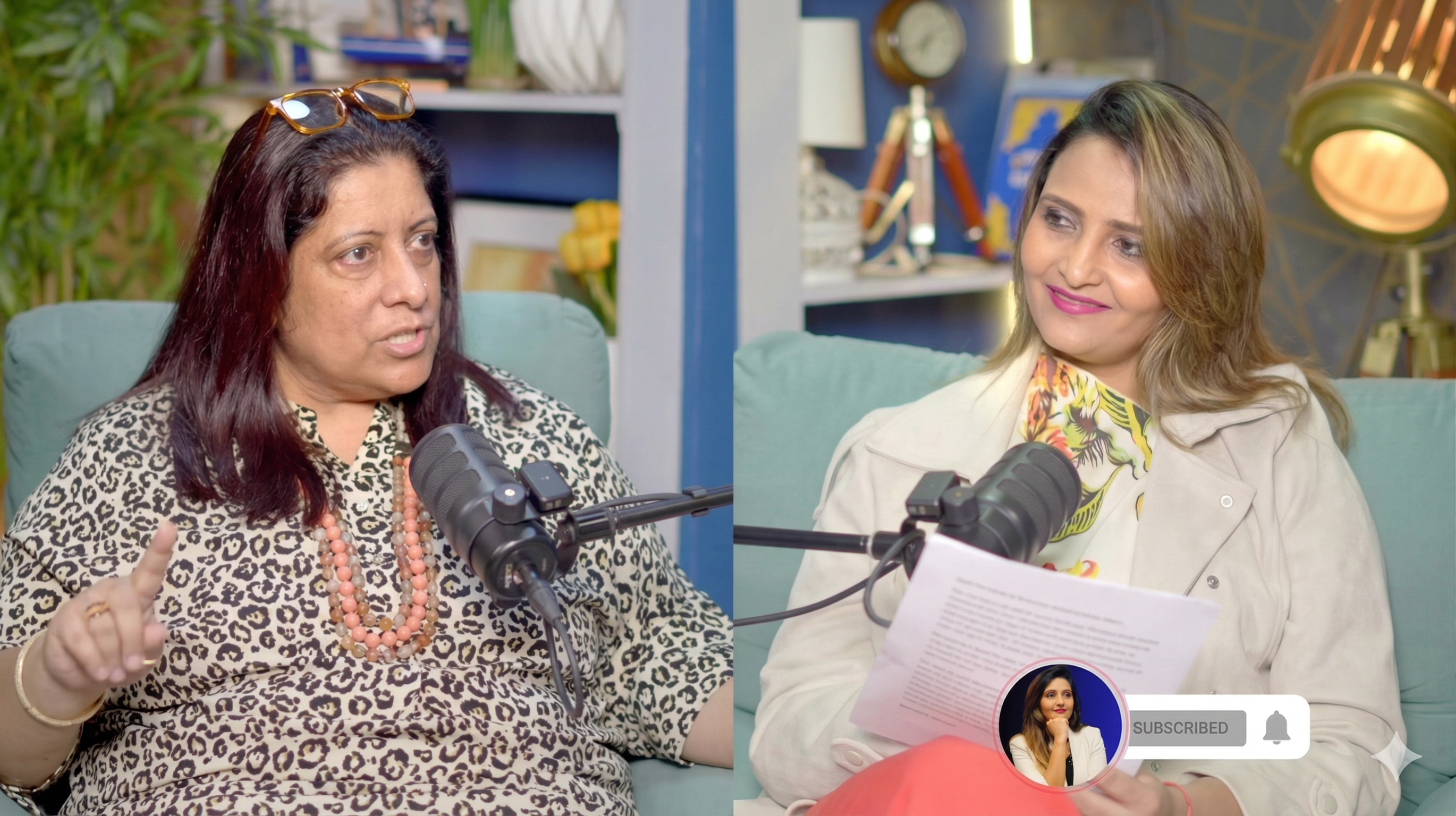
With 490 preschools and 35 years in education, Dr. Swati Popat Vats speaks about NEP 2020, teacher pay, storytelling, and what India is getting dangerously wrong about early childhood — on Ek Soch Podcast.
Mumbai: A neglected child may grow into a terrorist. A nurtured one may become a surgeon. Dr. Swati Popat Vats has spent thirty-five years arguing that the difference between those two outcomes is decided not in adolescence, not in school examinations, but in the earliest years of a child's life — years that India continues to treat as a warm-up for real education.
In a recent conversation on the Ek Soch Podcast with host Nirale Pandya, Dr. Swati — founder director of Podar Jumbo Kids, president of the Early Childhood Association of India, and one of the most recognised voices in Indian early childhood education — covered the full landscape of what is broken, what is possible, and what every parent, teacher, and policymaker needs to understand about the first six years.
"She has built 490 preschools across three countries. Her most urgent message is not about infrastructure — it is about what happens inside a classroom in the first six years of a child's life."
A Career That Began With a Fight at Eighteen
Dr. Swati Popat Vats did not drift into education. She chose it at eighteen, against her father's resistance, because the childhood game of playing teacher had never felt like a game to her. It felt like a direction.
That decision, made over three decades ago, has resulted in a body of work that spans curriculum design, institutional building, policy advocacy, and storytelling — across India, Nepal, and Qatar. She set up schools under her consultancy Tasha, served as founder consultant for the first hundred EuroKids schools, and eventually built Podar Jumbo Kids into a network of approximately 490 preschools.
The scale is significant. The conviction behind it — that early childhood is not a holding period before real learning begins but the most consequential developmental window in a human life — has not changed since she was eighteen.
The Dying Art That Belongs in Every Classroom
Alongside her institutional work, Dr. Swati runs a second company rooted in puppetry and storytelling — an art form she describes as dying, and one whose loss she considers a genuine educational crisis.
Her argument for storytelling in classrooms is not sentimental. It is pedagogical. When subject matter is taught through narrative, the relationship between the learner and the content transforms. Children do not receive information — they enter a world. She extends this principle beyond literature and history into mathematics: even algebra, she argues, has a story, and teaching it through that story changes what children retain and how they think.
She emphasises audio-only storytelling specifically — stories told without images — as a uniquely powerful tool for developing imagination and creative thinking, precisely because the child's mind must build the visual world entirely from within. Her collaboration with Prithvi Theatre to establish Storytellers of Prithvi for child audiences is a direct expression of this conviction.
The Indian Educator Most Indians Have Never Heard Of
One of the most striking moments in the conversation involves a name that most people — including most professional educators in India — will not recognise.
Gijubhai Badheka was a lawyer turned educator working in the early 1900s who wrote four hundred stories for children and developed a child-centric pedagogy that was entirely indigenous to India. He built a philosophy of education grounded in the child's natural curiosity, play, and storytelling — decades before the international early childhood education frameworks that India now imports and adapts.
Dr. Swati co-authored the first book written about him. Her frustration is specific: India has produced one of the world's most significant early childhood education thinkers, and the profession that most needs to know him has largely forgotten he existed.
What NEP 2020 Actually Says — and Who Has Read It
India's National Education Policy 2020 was the country's first major education policy revision in thirty-two years. Dr. Swati's assessment of its reception within the education community is blunt: most educators have not read it.
The policy is followed by two National Curriculum Frameworks — NCF 2022, covering the foundational stage, and NCF 2023, covering school education. Together, these three documents represent the most comprehensive articulation of India's educational direction in a generation. Dr. Swati has created an A-to-Z guide covering all three, available to anyone who engages with her directly.
"For the first time, India's education policy formally includes the three-to-six age group within the framework of formal education."
The Teacher Pay Problem India Is Not Discussing
Government primary school teachers in India earn over one lakh rupees per month under the Seventh Pay Commission. Private preschool teachers — who are working with children at the most critical developmental stage — are among the most severely underpaid professionals in the education sector.
Dr. Swati does not frame this as an observation. She frames it as a crisis with a direct consequence: when the profession does not pay, it does not attract the most qualified people, and the children who need the most skilled educators receive the least experienced ones.
Her comparison to Finland is pointed. Finland pays teachers on par with doctors and engineers — a government-set standard that reflects a national decision about what the profession is worth. India's private sector, she argues, should not wait for government mandates to raise its own standards. NEP's formal inclusion of the three-to-six age group creates both the obligation and the framework to begin doing so now.
What the Pandemic Did to an Entire Generation of Children
Dr. Swati's account of the post-pandemic developmental landscape among young children is specific and sobering.
Two years of online schooling removed the physical, social, and emotional experiences that children between three and six require to develop normally. These are not abstract developmental milestones — they are the foundational experiences through which children learn how close to stand near another person, how to read facial expressions, how to manage frustration in a shared physical space, how to lose a game without falling apart.
Children returning to classrooms after the pandemic had missed these experiences entirely. Anxiety and aggression rose measurably. The gaps were not academic — they were human. And unlike academic gaps, they could not be addressed with additional worksheets or catch-up curricula.
What Indian Parents Are Getting Wrong
Dr. Swati is careful about how she addresses parenting — she is explicit that parents need mentors, not judgement. But she is equally clear about a specific pattern she sees as deeply counterproductive.
Indian parents are, as a generation, fixated on worksheets and writing from the earliest possible age. They interpret the absence of formal written output from a two or three year old as evidence that learning is not happening. Schools, responding to parental pressure rather than child development research, increasingly provide exactly what parents are asking for — and in doing so, harm the children both parties intend to help.
A two year old who is scolded for not sharing is being held to a developmental standard they are biologically incapable of meeting. Genuine sharing — the voluntary giving of something valued to another person — requires a level of cognitive and emotional development that simply does not exist at two. The expectation is not a high standard. It is an uninformed one.
Her call is for parent education to be treated as seriously as child education — and for schools to hold their pedagogical ground even when parents push back.
The Working Mother, the Daycare, and the Economy
Dr. Swati addresses directly one of the most persistent sources of guilt and confusion for working mothers in India.
Sending a two year old to a daycare or play school is not wrong. What is wrong, she argues, is sending a two year old to an institution that teaches letters and numbers to two year olds — not because the child is too young to be away from home, but because the institution is providing developmentally inappropriate content that actively interferes with natural development.
The distinction matters for a reason beyond individual families. When paediatricians or social commentators blame daycares categorically for developmental or health problems in young children, the effect is to discourage working mothers from re-entering the workforce. The economic consequence of that discouragement — multiplied across millions of households — is not a personal outcome. It is a structural one.
Three Things She Tells Every Education Entrepreneur
Dr. Swati's advice to anyone entering the early childhood education sector as a business is structured around three non-negotiable principles.
The first is full involvement. An education entrepreneur who does not understand curriculum, finance, marketing, and legal requirements simultaneously is not running a school — they are operating a partial business that will eventually fail in the dimension they have neglected.
The second is motivation. If the primary reason for entering the sector is financial return, the damage done — to children who are placed in an environment that prioritises profit over developmental appropriateness — is not recoverable. She is direct: you will harm children's lives.
"Saraswati first, Lakshmi follows."
The third is qualification. Her formulation of this is precise: the financial return from early childhood education is real and sustainable, but it follows from genuine expertise — not from branding, location, or fee structures alone.
The Larger World India Is Not Building for Its Children
Dr. Swati closes the conversation by widening the frame from classrooms to the physical and social environment in which Indian children grow up.
Indian cities, roads, and public transport are not designed with children in mind. Children appearing in films and television productions lack adequate legal protection. The inclusion of children with special needs in mainstream educational and social settings remains largely aspirational rather than operational.
She notes Bengaluru Airport as a rare positive example — the first Indian airport to install a sensory room for children with sensory processing differences. It is a small detail. It is also evidence that child-friendly design is possible in India when someone decides it is a priority.
Her closing thought is the one she returns to throughout the conversation: the time to act is now. Not when policy is perfect, not when pay scales are aligned, not when every parent has been educated. Now — because the children whose early years are passing without appropriate support will not get those years back.
Nirale Pandya
Entrepreneur | Podcaster
"I help businesses grow through strategic PR, Branding, Business Consultation, Social Media Management, Digital Marketing, and Podcasting."
📅 Book a One-to-One Business Consultation:
Schedule Your Session🔗 Connect With Me
Published: Mar 30, 2026 | Category: Podcast