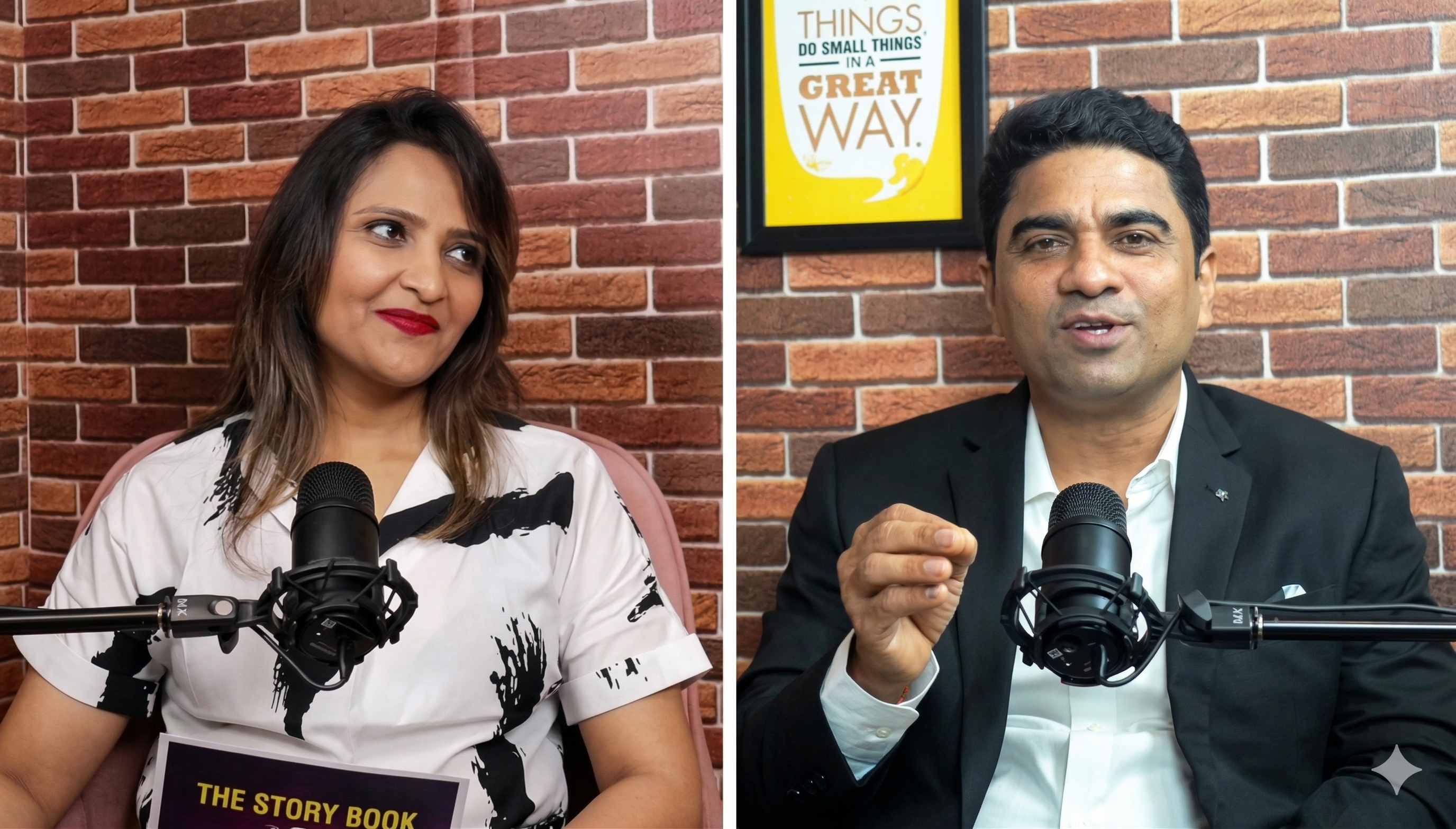
Business coach Dr. Bharat Vishe explains why most Indian entrepreneurs stay stuck in self-employment and how to build a system-driven scalable business — on Ek Soch Podcast.
Pune: There are an estimated 63 million small and medium businesses in India. According to Dr. Bharat Vishe, between 95 and 98 percent of their owners are not running a business. They are doing self-employment — and there is a critical difference between the two.
In a recent conversation on the Ek Soch Podcast with host Nirale Pandya, Dr. Vishe — founder of Business Vista and Vish Education, business coach, and author — laid out with precision why most entrepreneurs stay stuck at the same revenue year after year, and what it actually takes to build a business that runs without the owner in the room.
"Most Indian business owners wanted freedom. Instead they built themselves a seven-day-a-week job."
From Salesperson to Systems Builder
Dr. Bharat Vishe's first chapter was not entrepreneurship. It was sales — a career in jobs that gave him ground-level understanding of how businesses acquire and retain customers. In 2007, he founded Vish Education, a coaching institute built around a specific pain point he had observed: students who performed well academically but consistently failed at entrance examinations. The gap was not intelligence. It was preparation method.
Over a decade of building Vish Education — including scaling it from one centre to twenty — he accumulated a parallel education of his own: in the mistakes, inefficiencies, and traps that first-generation business owners fall into. In 2018, he launched Business Vista specifically to help other entrepreneurs avoid what he had learned the hard way.
The Difference Between Busy and Business
The central argument Dr. Vishe makes is deceptively simple. Most business owners are busy. Very few are building a business.
The distinction is operational. A busy owner handles customers, manages staff conflicts, oversees accounts, drives sales, and answers every problem that walks through the door — seven days a week, with no separation between their identity and the entity they founded. Revenue stays flat not because the market is wrong or the product is weak, but because the owner has become the bottleneck for every decision.
Working on the business — on strategy, systems, customer insight, and team development — requires stepping back from working in it. Most owners never make that transition. The daily operational weight makes it feel impossible, and nobody has shown them the sequence for doing it.
Good People Are Not Found. They Are Created.
One of the most repeated complaints Dr. Vishe hears from struggling entrepreneurs is that good employees do not exist. His response is direct: good employees are not found, they are built.
The framework he uses for delegation is sequential and specific. It begins with the owner doing a task while the team member observes. It moves to the team member doing the task while the owner watches. It ends with the team member executing independently while the owner only reviews outcomes.
This process requires the owner to document what they know — to convert personal expertise into written scripts, defined steps, and measurable KRAs. He gives a practical example: a receptionist or telecaller role with a clearly scripted process and defined daily call counts. A new hire following that system on their first week can deliver results comparable to someone who has been doing the job informally for years.
"The test of whether a system is real is simple: does the business operate the same way when the owner is not present?"
What a Real Business Coach Actually Does
Dr. Vishe is careful about how he defines a business coach, because the term has been diluted by the motivational content industry.
A real coach, in his definition, is someone who is actively running multiple businesses with their own teams and systems — not someone whose primary product is inspiration. The value a coach provides is third-party perspective, structured process design, and step-by-step accountability that is tailored to a specific business's stage and challenges.
Free YouTube content, he acknowledges, can provide concepts and frameworks. It cannot provide sequence, feedback, or the ongoing pressure of accountability that paid, structured engagement creates. Inspiration without implementation changes nothing on a balance sheet.
"A coach will not grow your business for you. Results depend equally on the business owner doing their half of the work."
Marketing Is Not Seasonal
Dr. Vishe separates marketing from sales in a way that many small business owners conflate. Sales is the conversion of an interested customer. Marketing is the continuous activity that creates interested customers in the first place.
The pattern he sees repeatedly is businesses that run advertisements during Diwali, wedding season, or other peak periods and then go dark. This approach, he argues, is structurally incapable of building long-term trust or brand recall.
His view of what will separate future winners from those left behind is specific: businesses with in-house content creation teams producing consistent, value-adding material — not seasonal campaigns, not jugaad, not short-term tactics. The shop, as he puts it, must be open every day.
The Founder as the Business's Most Important Product
A thread running through the entire conversation is the idea that the founder's personal discipline is the ceiling on the business's growth.
Dr. Vishe's own daily structure includes approximately ninety minutes of reading business-relevant books and content, around an hour of physical exercise, and dedicated quiet time. He describes his book, 21 Secrets to Unlock Your Success, as a condensed version of two decades of lessons — focused not on abstract motivation but on the specific mindset and discipline shifts that precede measurable change.
"At the end of each day, identify what you did right and what did not serve your goals. No drama, no self-criticism — just honest operational review."
The One Action He Asks For
Dr. Vishe closes with a challenge he gives to every entrepreneur who engages with his content or programs: take at least one concrete action immediately from whatever you have just consumed.
Clarity without action produces no result. Motivation without implementation produces no revenue. The gap between where most Indian business owners are and where they want to be is not information — it is the courage to invest in learning and the discipline to execute on what is learned.
"Freedom does not arrive. It is built — process by process, hire by hire, decision by decision."
Nirale Pandya
Entrepreneur | Podcaster
"I help businesses grow through strategic PR, Branding, Business Consultation, Social Media Management, Digital Marketing, and Podcasting."
📅 Book a One-to-One Business Consultation:
Schedule Your Session🔗 Connect With Me
Published: Mar 24, 2026 | Category: Podcast