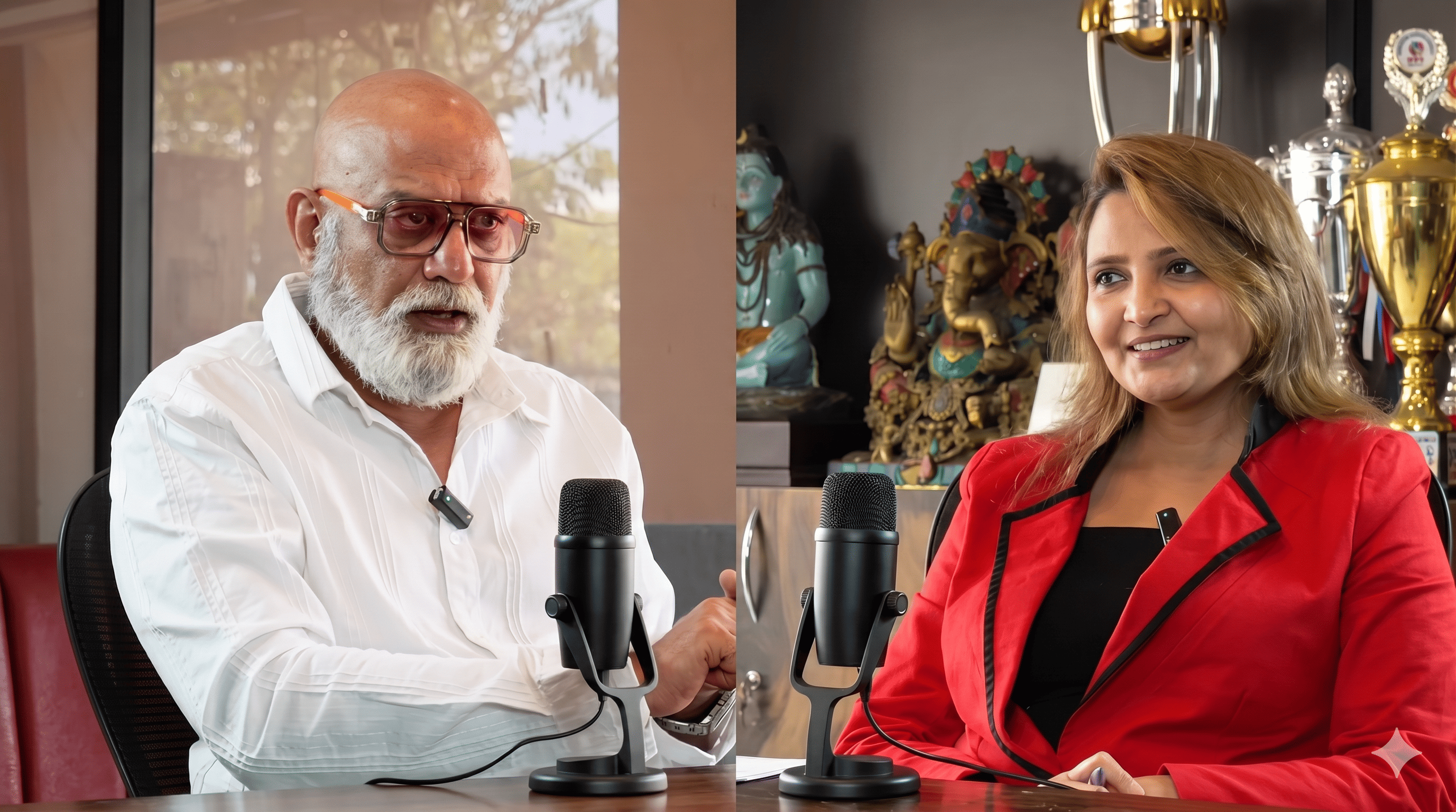
Mumbai: A person struggling with addiction, depression, or family conflict is often told to seek help. The help that materialises is usually medication, or judgment, or both. Rarely is it music. Rarely is it conversation without agenda. Rarely is it someone willing to sit with them in their silence and help them reconnect with themselves.
In a recent conversation on the Ek Soch Podcast with host Nirale Pandya, Dr. Roshan Mansukhani — a music therapist and counselor who spent 18 years in events and DJing before his own breakdown became his greatest teacher — walked through how he discovered music therapy through personal crisis, why the root of addiction is not the substance but the absence of honest conversation, how music can be used intentionally as healing alongside medication, and why parents and society are teaching children to suppress emotions rather than to express them.
"He had a lucrative career in events and DJing. Then he hit rock bottom and disappeared for two years. What he discovered in that silence became the music therapy that now heals people from addiction, depression, and family shame."
From Events to Rock Bottom: The Vacuum Inside Success
Roshan Mansukhani built a successful career in corporate events and DJing. The work was lucrative. The lifestyle seemed enviable. People knew his name. His events were celebrated.
Yet beneath this exterior success, he felt an inner vacuum. He was performing authenticity rather than being authentic. He was surrounded by people but disconnected from genuine connection. The dissonance between the external appearance and the internal reality grew until it became unbearable.
He hit rock bottom. The breaking point came when the contradiction between who he was pretending to be and who he actually was became too great to sustain. Rather than trying to fix this while continuing to perform, he did something radical: he disappeared.
For two years, he withdrew from the world. He disconnected from career, from social obligations, from the need to maintain any image. In that silence and isolation, he reconnected with himself. He discovered that failure was not something to fear. Failure was the necessary prerequisite to appreciating later success.
Music as Medicine: Testing Therapy on Himself
During his two-year withdrawal, Roshan used music intentionally on himself as his own medicine.
He was not using music passively — playing songs for comfort. He was using music actively — curating specific songs, listening with specific intentions, allowing emotions to surface, processing what the music brought up. He was experimenting on himself with what would later become his music therapy module.
The experimentation worked. The music combined with silence and self-reflection created the conditions for healing. He emerged from those two years transformed. Not because the problems had disappeared, but because he had learned to be present with himself rather than running from what he felt.
This personal experiment became the foundation for his later work with others. He understood from lived experience that music, combined with honest conversation and emotional presence, could facilitate healing that medication alone could not.
Music Therapy Defined Simply
Roshan defines music therapy in accessible terms: everyday sound and music around us — even recorded voice without lyrics — can be used intentionally as therapy.
It is not a complex technical process that requires special training in music or mental health. It is the simple practice of using sound and music consciously, with a specific intention, to help emotions surface and be processed.
His sessions happen in a home-like setting, not in a clinical environment. He reads body language. He gives curated "music exercises" delivered on headphones with specific thought prompts. He creates space for emotions to surface through the music. He listens and responds.
The music is secondary to the conversation. Music therapy without honest conversation is incomplete. Conversation without music can reach only the intellectual mind. Together, they reach the emotional and spiritual dimensions that medication and diagnosis miss.
The Root Cause: Lack of Healthy Family Conversation
Roshan rejects the idea that there is a "common" underlying problem causing addiction across different people.
Instead, he identifies one consistent pattern: lack of healthy, judgment-free conversation within families. A person turns to substances not because of a chemical deficiency or a psychological flaw. They turn to substances because they have nowhere safe to express what they feel. They have no one who listens without judgment. They have no space to be honest.
The family environment teaches them that certain emotions are unacceptable. Vulnerability is weakness. Pain should be hidden. Struggle should be suffered silently. When this pattern is established, the person learns to numb themselves — through substances, through screens, through any escape available.
Roshan's approach to addiction therefore bypasses the substance entirely. He addresses the family dynamic that created the need to escape. He helps the person reconnect with what they were running from. He creates space for the honest conversation that was missing.
The Damage of Labels: Dropping "Drug Addict," Restoring the Person
Roshan is vocal about a practice that he believes perpetuates shame and prevents healing: labeling.
When a person is called a "drug addict," that label becomes their identity. It is permanent. It is all others see. It is what they come to believe about themselves. The person is erased. Only the label remains.
His approach is to drop the label entirely. A person who used substances is not an "addict." They are a person who needed escape and found it through substances. The distinction is subtle but profound. One framing is identity. The other is behaviour.
When a person who has used substances re-enters society or family, they should be welcomed by name, not by label. They should be seen as a person returning, not as a permanently damaged goods. This shift in how they are perceived creates the psychological safety necessary for genuine healing.
Comparison and Judgment at Home Are More Damaging Than Peer Pressure
Roshan identifies the primary source of psychological damage for youth: not peer pressure or social media, but comparison and judgment within families.
A parent constantly comparing their child to siblings, to cousins, to other children in the neighbourhood teaches the child that their worth is conditional. They are valued only if they exceed others. This creates a fragile sense of self that is entirely dependent on external validation.
When the child inevitably faces situations where they cannot outperform others, their sense of self collapses. They are not inherently worthy. They are only worthy if they achieve more.
The solution Roshan proposes to parents is fundamental: shift from being authority figures who judge to being genuine friends who have open, honest conversations. These conversations should sometimes be heated. They should sometimes feel cathartic. They should be spaces where bottled-up grudges and emotions can pour out without fear of retaliation or withdrawal of love.
Parents who create this space raise children who do not need to escape through substances or screens. They have a safe place to process what they feel at home.
Addiction Expands: Screens, Status, and Consumerism
Roshan expands the definition of addiction beyond drugs to include phones, screens, and status-driven consumerism.
A person can be addicted to social media approval. Addicted to shopping. Addicted to maintaining an image. These addictions are not fundamentally different from substance addiction. They serve the same function: numbing and escape.
Technology should be welcomed and used. But it should be consciously curtailed. Most people use technology passively, absorbing it, being shaped by it. The healthier approach is to use technology intentionally, on your terms, for specific purposes, then to step away.
Roshan also critiques the casual misuse of mental health language. People claim to be depressed because their phone broke. They claim to be anxious about minor social situations. This misuse of language dilutes the meaning and creates over-sensitization. It also prevents people from recognising when they are actually experiencing serious mental health challenges.
Music Therapy as Accelerator, Not Replacement
Roshan is clear: music therapy is not a replacement for medication. It is a complementary accelerator that helps medical treatment work faster.
A person taking medication for depression is receiving help. That same person receiving music therapy alongside medication experiences faster improvement because the music soothes and organises the mind, creating better conditions for the medication to work.
He shares a case where a woman was in a coma. Working with her doctors' permission, he used curated, time-bound music to help bring her back to consciousness. Within five days, she was awake and recovering. The music did not replace the medical treatment. It accelerated it.
In another case, he combined mental work with a naturopath's physical treatment to help a man with severe back pain. The pain had kept the man from sitting for more than a few minutes. After combining approaches, the man could sit for 45 minutes. Neither approach alone would have produced that result. Together, they did.
Mental Health Checkups: As Routine as Physical Checkups
Roshan argues for a cultural shift: mental health checkups should be as routine and as mandatory as physical checkups.
Most people wait until they have a crisis to seek mental health support. By then, the problem has festered. Small "ant-sized" thoughts have become serious issues because they were never examined or processed.
If people had regular conversations with a non-judgmental therapist or counselor — even once a year as a maintenance check — many problems would be caught and resolved before they escalated.
The barrier to this is stigma. The phrase "mental health checkup" itself sounds scary and implies something is wrong. Roshan's approach is to reframe it: mental health checkups are not for people who are broken. They are for people who want to stay healthy. They are preventive care.
Gender Norms and Emotional Suppression: Boys Don't Cry
Roshan critiques the cultural scripts that are taught from childhood, particularly to boys.
"Don't behave like a girl." "Boys don't cry." "Be strong." These messages teach boys that emotions are weakness. They teach boys that vulnerability is unacceptable. The result is a generation of men who are emotionally stunted, who cannot express themselves, who are isolated in their struggles.
This emotional suppression does not make boys stronger. It makes them sicker. They carry everything internally, with no outlet. They develop stress, anxiety, depression — all rooted in the inability to express what they feel.
Girls receive different but equally harmful messages: be nice, be accommodating, suppress your anger, make others comfortable. Both genders are taught to suppress authentic emotion in favour of a cultural script.
Roshan argues for a different approach: emotions are not gendered. Crying is not female. Strength is not male. A healthy human — of any gender — can feel a full range of emotions and can express them appropriately.
Basic Emotions and Fashionable Labels
Roshan makes an observation about the language used to describe emotional states: many terms that are now treated as distinct conditions are actually variations on basic human emotions.
At the most fundamental level, humans have two basic emotional states: smiling when pleased and crying when in pain or need. Everything else — anxiety, fear, depression — are layers of meaning, comparison, and expectation added on top of these basics.
When society piles expectations and labels onto people, what was a basic emotional response becomes a "condition" requiring intervention. A natural sadness becomes "depression." Natural nervousness becomes "anxiety." Natural fear becomes a "disorder."
This is not to say that clinical depression and anxiety do not exist. They do. But Roshan argues that casual use of these labels for normal human emotional responses dilutes the language and prevents people from recognising when they are experiencing something that actually requires intervention.
Living Versus Surviving: The Hardest Challenge Is Doing Nothing
Roshan draws a sharp distinction between truly living and merely surviving.
Most people are surviving. Constant road rage, overwork, financial stress, the need to perform and achieve — these are signs of survival mode, not living. Living involves reflection, connection, time with oneself and loved ones, presence in the moment.
He identifies "doing nothing" as the hardest challenge today. The cultural message is that every moment should be productive, monetised, or at least visible on social media. The idea of simply being still, doing nothing, reflecting — this is treated as laziness rather than as healing.
Yet Roshan discovered that doing nothing is where healing happens. In his two-year withdrawal, he was not "productive" in any conventional sense. He was not earning money. He was not building a business. He was simply being. And in that stillness, he reconnected with himself.
Practical Guidance for Parents
Roshan's core message to parents is simple: create space for judgment-free dialogue.
Scale down expectations around grades and performance. Prioritise a healthy, emotionally open child over achievement metrics. Listen more than you speak. Ask questions you genuinely want to know the answers to. Be willing to be challenged. Be willing to admit when you were wrong.
When conflict arises, treat it as information rather than as opposition. The conflict is telling you something about your child's world, their struggle, their needs. Listen to the message, not just the behaviour.
Practical Guidance for Youth and Adults
For youth and adults struggling, Roshan's message is equally simple: reach out for help without shame.
Use music consciously, not just passively. Choose music intentionally for what you need to feel and process. Let the music bring emotions to the surface. Have the conversation you need to have.
Learn to disconnect from external noise — technology, social comparison, fear-based messaging. Reconnect with your own inner world. Discover what you actually feel when you are not performing for anyone else.
Nirale Pandya
Entrepreneur | Podcaster
"I help businesses grow through strategic PR, Branding, Business Consultation, Social Media Management, Digital Marketing, and Podcasting."
📅 Book a One-to-One Business Consultation:
Schedule Your Session🔗 Connect With Me