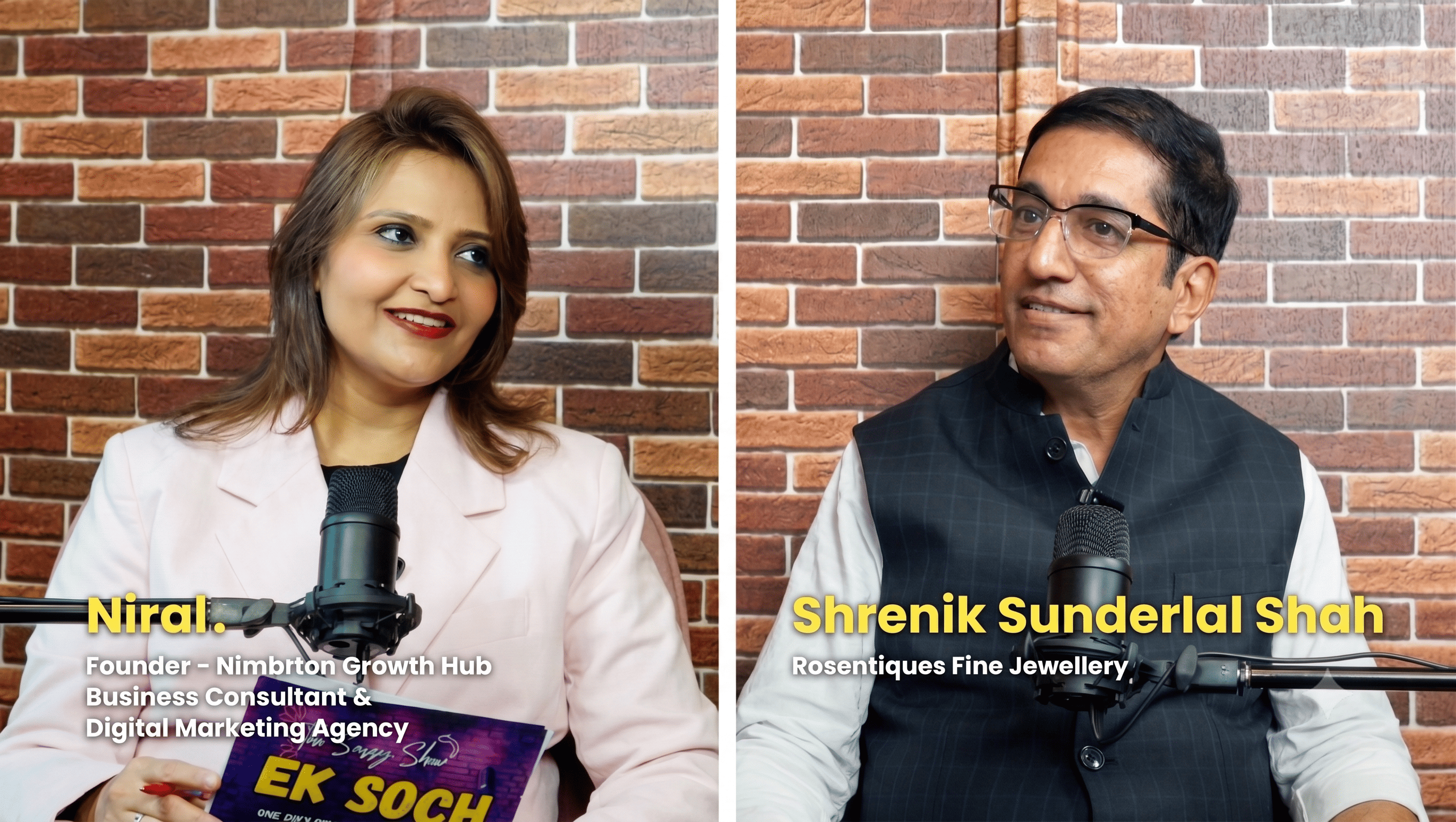
Mumbai: The jewellery business seems simple on the surface: acquire gems and gold, sell at a margin, collect profit. But anyone who has spent even a few years in the industry understands that jewellery is not primarily a product business. It is a trust business. A person does not buy jewellery because they need it. They buy jewellery because they trust the person selling it.
In a recent conversation on the Ek Soch Podcast with host Nirale Pandya, Shrenik Sunderlal Shah — founder of Rozantic Fine Jewellery, bestselling author, and entrepreneur — walked through his transition from pharmaceuticals to jewellery, how trust actually builds in a market where every transaction carries risk, why branding yourself as an individual is as important as branding your company, and how the philosophy of karma shapes both his business decisions and his life choices.
"He left pharmaceuticals for jewellery. He built a brand not through advertising, but through a single core principle: trust takes years, but betrayal takes a moment."
From Pharmaceuticals to Jewellery: The Pivot
Shrenik's journey into jewellery came not from childhood aspiration but from a simple message from his sister in Mumbai.
He was running a pharma manufacturing business in Vapi, Gujarat — stable, predictable, successful. The business worked. But there was a pull toward something different, something that would take him in a new direction. When his sister, who was already in the jewellery business in Mumbai, reached out and suggested they explore jewellery together, the idea resonated.
He and his wife made the decision to shift their focus. They left the stability of pharmaceutical manufacturing and moved into jewellery. The move was not made on the basis of research or detailed planning. It was made on the basis of listening to an intuition that the next chapter was in jewellery, not in pharma.
Building Rozantic: From B2B to Beloved Brand
Rozantic began as a B2B jewellery business — supplying to retailers and wholesalers rather than directly to consumers.
Over eighteen years, the business transformed. Rozantic developed an in-house design team and CAD capabilities, allowing them to create unique pieces rather than simply manufacturing to spec. The company won national and international awards for distinctive jewellery across both gold and diamond segments. The business grew from purely B2B to a respected brand that consumers knew and trusted.
The growth was not driven by marketing campaigns or celebrity endorsements. It was built on a foundation that Shrenik identifies as more important than any advertising: quality, consistency, and the slow accumulation of trust through repeated positive experiences.
The Market Shift: Premium Feeling, Reasonable Price
Shrenik identifies a significant shift in what young India wants from jewellery.
Previously, jewellery was categorised into two buckets: expensive fine jewellery for special occasions and occasions that justified the cost, and costume jewellery for everyday wear. Young India today wants a third option: pieces that feel and look premium but are priced reasonably. Daily-wear jewellery that does not create anxiety about wearing it, that does not require a special occasion to justify its existence.
This shift is driven partly by Western-style everyday accessorising, where jewellery is integrated into daily appearance rather than reserved for special events. A person who wears jewellery every day but does not want to wear their most expensive pieces every day needs jewellery that bridges the gap: premium-looking pieces at a price that allows them to be worn without fear.
Rozantic positioned itself to serve this market — creating jewellery that feels fine but is accessible to young, working Indians who want daily-wear elegance.
Trust: The Real Product in Jewellery
Shrenik identifies something fundamental about the jewellery business that most people in the industry understand but few discuss openly: trust is the actual product being sold, not the gold or the diamonds.
When a person walks into a jewellery store, they are making a significant purchase. Gold has resale value, but at any given moment, the buyer has no way to verify the exact quality, the purity, the fairness of the price. They are buying based on trust in the seller. They are believing that the seller is not cheating them, is not replacing gold with a lighter alloy, is not overcharging them for a diamond.
This trust is not built overnight. It builds over months and years through consistent behavior: transparent pricing, high-quality pieces that last, after-sales service that actually works, and a willingness to stand behind what was sold. It is built through showing the customer repeatedly that the business will not sacrifice their trust for a short-term profit.
A person who betrays that trust, even once, loses it completely. But building it requires consistent integrity across hundreds of transactions over years. Shrenik's approach has been to prioritise that trust-building over rapid sales growth, accepting that growth will be slower but more sustainable.
Branding Yourself: The Individual Is the Brand
Shrenik credits a mentor named Devgadvi with a reframing that shaped his entire approach to personal branding: an ordinary individual — not just celebrities — can write a book and become a brand.
This insight shifted Shrenik's understanding of what was possible. He did not need to be a movie star or a sports figure to have influence. He could develop ideas, express them through writing, and build credibility and recognition through that work.
This led him to write two bestselling books on Amazon: "Why Only Me?" in English and its Hindi edition "Mere Saath Aisa Kyun?" Both books explore the Law of Karma — the principle that everything experienced in life is a result of past karma. The books are not technical treatises. They are reflections on how karma shapes daily life and how understanding karma changes how a person approaches success and failure.
The books became a second platform for Shrenik, separating him from being solely "the jewellery business owner" and establishing him as a thinker and author with ideas worth reading. This branding of himself as an individual elevated the entire Rozantic brand by association.
Networking: Built on Consistency, Not Transaction
Shrenik describes networking not as a transactional activity where you collect business cards and connections, but as a practice of showing up consistently with genuine interest.
His approach is practical and specific. He attends events where interesting people gather. He follows celebrities and notices their public appearances so he knows where they will be. He builds relationships gradually through repeated presence in spaces where people of aligned interests meet.
The key to his networking is that it is driven by genuine curiosity and interest, not by what he can extract from the relationship. He is there because he wants to meet people, to understand what they are doing, to see if there is alignment. The business benefits that come from networking are secondary to the interest itself.
This approach requires patience. A single conversation at an event does not create a relationship. But showing up at multiple events, engaging consistently with people, and building familiarity over time creates the foundation for relationships that might eventually produce collaboration.
The Three Steps to Build a Powerful Network
Shrenik distils his networking philosophy into three specific steps that any person can follow.
First, achieve some level of success yourself. Networking works better when you have something to contribute to conversations, not just something to extract. A person who has built something, achieved something, or created something interesting is more valuable in a network than a person who is purely seeking.
Second, leverage social media platforms like Instagram and YouTube for visibility. These platforms allow you to reach people at scale without geographic limitation. A consistent presence on social media means that when you eventually meet someone in person, they may already be familiar with your work or your ideas.
Third, use authorship and events as credibility anchors that get you invited into the right rooms. Writing a book establishes authority in a way that casual credentials do not. Speaking at events or hosting events creates touchpoints where people want to engage with you.
These three steps work together: the work you do creates visibility, the social media amplifies that visibility, and the authorship and event participation give you a legitimate reason to be in spaces where influential people gather.
The Governor and the Gift Book: Seizing the Moment
One story illustrates Shrenik's approach to networking: his encounter with the Governor of Maharashtra.
Shrenik spotted the Governor leaving a hotel. He recognised the moment as an opportunity and overcame the hesitation about security protocols to approach and gift his book to the Governor. The gesture was simple: sharing his written work with an influential person.
The moment was captured in a photograph, though the hotel staff later deleted it. But one photo survived and made its way to social media. The story is not about the photo. It is about the willingness to recognise an opportunity, to approach it directly, and to offer something of value without expectation of immediate return.
This is how many of Shrenik's significant connections began: not through planned networking meetings, but through recognising moments when he could connect with someone and acting on that recognition.
The Law of Karma: This Life and the Next
Shrenik's philosophical framework, explored extensively in his books, centres on the Law of Karma and how it shapes not just this life but the next.
Most people, he argues, think about success exclusively in terms of this life. They want wealth, recognition, and comfort in this lifetime. What they do not think about is the karmic investment they are making for their next life. By performing good deeds now, by treating people with integrity, by choosing principle over profit, they are investing in their soul's future beyond death.
This is not merely a spiritual concept in Shrenik's framing. It is a practical principle that should shape business decisions. A business owner who chooses to betray a customer for a short-term profit is making a decision about their next life, not just their current bank balance.
This framework liberates Shrenik from the constant anxiety of maximising profit in every transaction. It allows him to make decisions based on longer time horizons — both the length of his current life and the implied eternity of his next life.
Forgiveness as Investment in Your Own Future
Shrenik reframes forgiveness in a way that removes it from the realm of morality and places it in the realm of self-interest.
When someone wrongs you, they are, in Shrenik's framework, returning what your soul owed them from a past life. The wrong you are experiencing is your debt being collected. Forgiving them is not weakness. It is not a gift to them. It is an investment in your own present and future — releasing the energetic debt so it does not carry into your next life.
This reframing of forgiveness removes the element of sacrifice or moral superiority. You are not forgiving because you are better than they are. You are forgiving because holding the grievance harms your own karmic future. Forgiveness is enlightened self-interest.
This philosophy has profound practical implications for how Shrenik conducts business and relationships. It prevents the bitterness and resentment that can accumulate when people are wronged. It keeps him focused on moving forward rather than on being right.
The Prayer Meeting Test: Living a Life Worth Remembering
Shrenik closes his philosophy with a simple, powerful practice: imagining your own prayer meeting — the gathering after your death where people speak about your life.
What would people say about you? Would they speak of your wealth and accomplishments? Or would they speak of the impact you had on their lives, the integrity you maintained, the kindness you showed?
His advice is to live in a way that, when that prayer meeting happens, the words spoken about you reflect a life well-lived. Live so that you can laugh at death — not from fearlessness, but from the peace of knowing you lived in alignment with your values. Live in a way that the world mourns you not because you were important, but because you genuinely mattered to people's lives.
Nirale Pandya
Entrepreneur | Podcaster
"I help businesses grow through strategic PR, Branding, Business Consultation, Social Media Management, Digital Marketing, and Podcasting."
📅 Book a One-to-One Business Consultation:
Schedule Your Session🔗 Connect With Me