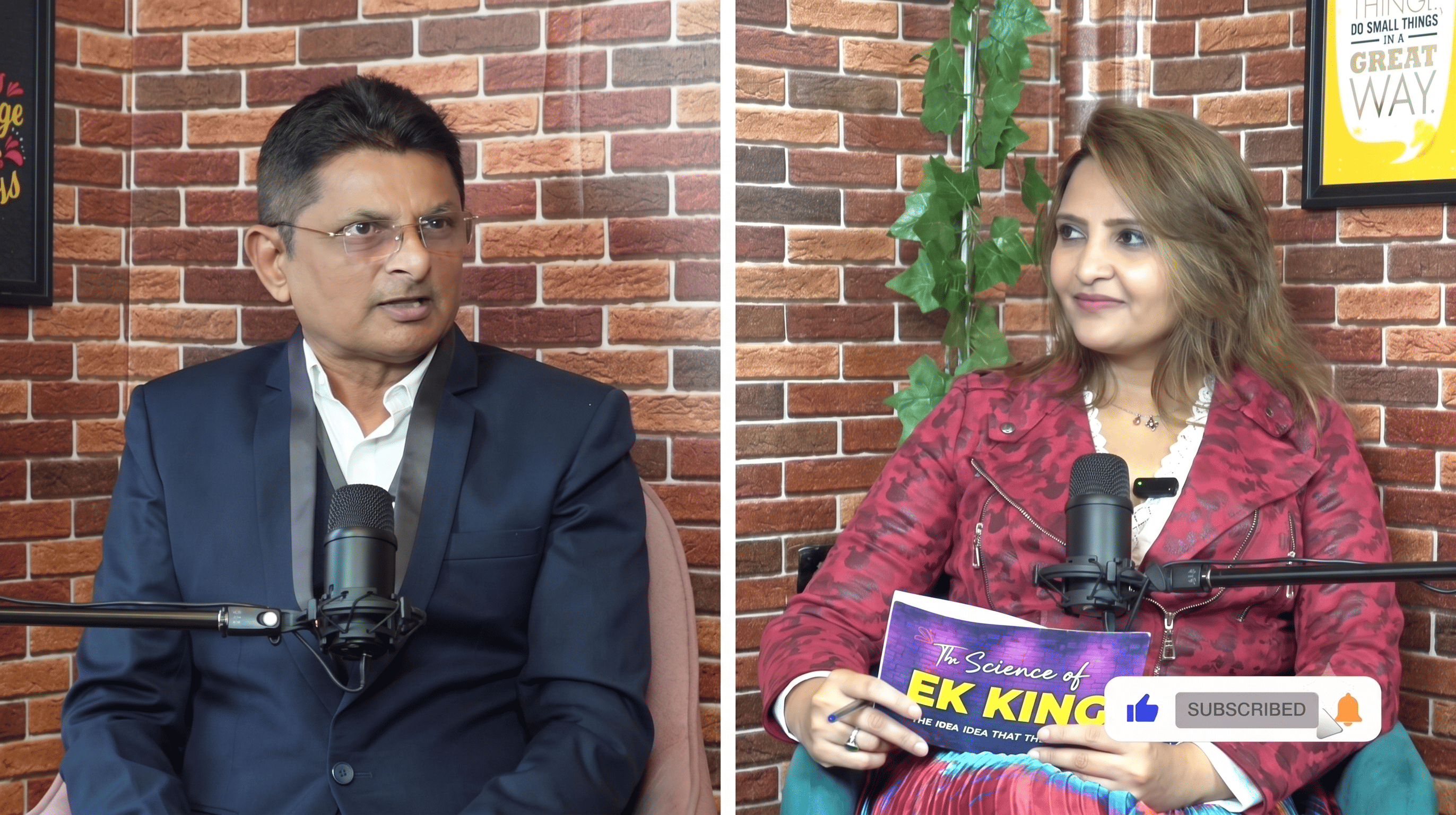
Mumbai: Most people treat financial planning as something to do eventually. When they have more money. When the children are older. When life settles down. When they feel ready. But readiness never arrives. The moment never comes. And then, at 60 or 65, they discover they have neither the capital nor the time to build the security they should have created years earlier.
Prakash Joshi learned a different lesson about financial planning when he was 22 years old. In a recent conversation on the Ek Soch Podcast with host Nirale Pandya, Prakash — a six-time LIC Million Dollar Round Table achiever with 30 years in insurance and financial advisory — walked through the shock that shaped his conviction, why financial stability is a prerequisite not just for comfort but for peace and spirituality, why 90 percent of Indians are dangerously underprepared for retirement, and what concrete steps a young professional should take before they even think about equity investments or mutual funds.
"His father lost his job abruptly. No savings. No backup. A 22-year-old fresh graduate became the family's earner. That one shock convinced him: financial stability is not a luxury. It is survival."
The Shock That Became His Conviction
Prakash's story begins with a crisis that most people, mercifully, never experience.
He had just graduated. He was making plans to pursue law school. His father was the earning member of the family, employed in a stable job. The path forward seemed clear.
Then, abruptly, his father lost his job. No warning. No severance. No savings. No backup. The family had no income. Prakash, at 22 years old, fresh from graduation, became the earning member. His plans for law school were abandoned. He needed to work immediately.
That shock created a conviction that would shape the next 30 years of his life: financial stability is not a luxury good. It is survival infrastructure. A person without financial backup is one job loss away from crisis. A family without emergency savings is one medical event away from disaster.
This is not an intellectual belief for Prakash. It is a lived belief, forged in the crucible of a crisis he did not choose but that he carries with him always.
Financial Stability as a Prerequisite for Peace and Spirituality
Prakash makes an observation that most spiritual teachers do not: genuine spiritual progress is almost impossible if your day-to-day finances are unstable.
He describes a period in his career when a business setback pushed him into deep crisis. The financial stress was immobilising. He could not meditate. He could not be present. He could not access any state of peace. The worry about money was all-consuming.
Only when he began rebuilding financial stability could he actually engage in spiritual practice. He started yoga, meditation, monthly silence days (maun), visits to old-age homes, involvement in a goshala. These practices were transformative. But they were only accessible after he had restored basic financial order.
This is an insight that contradicts the narrative that spirituality is separate from material security. Prakash argues that they are intimately connected. The person living in financial anxiety cannot access the mental calm that meditation requires. The person lying awake worrying about medical bills cannot access the presence that spiritual practice offers.
He notes that many revered spiritual figures who ultimately renounced the material world or redirected their lives toward spiritual purpose first had material security. They had the luxury of choice. Most people do not have that luxury. For most people, financial stability is the foundation that makes any other kind of progress possible.
The Crisis of Indian Financial Unpreparedness
Prakash identifies a structural reality that most Indians do not acknowledge: approximately 90 percent of people do not do serious retirement planning.
Instead, they rely on unstated expectations: the children will support them. The government pension will be adequate. Something will work out. These are not financial plans. These are hopes. And hopes are not sufficient when retirement actually arrives.
When Prakash interviews a 55-year-old person who has not seriously planned for retirement, the conversation is often devastating. The person has saved some money, but not enough. They have no corpus. They have no clear picture of what their post-retirement income will be. They are, in many cases, surprised to learn how much money is actually needed to live for 25 or 30 years without earning.
This lack of planning creates emotional and financial dependence on children. Adult children who are managing their own family expenses and their own financial goals suddenly find themselves supporting parents who did not plan for their own security. The guilt is mutual. The financial strain is real.
Financial literacy is low because parents focus on day-to-day spending and emotional sacrifice for children — prioritising education, family events, traditions — while neglecting systematic planning for education costs, health crises, and old age.
Education Costs: The Hidden Inflation
Prakash identifies a specific area where financial unpreparedness creates compounding crisis: education costs.
Most people assume that education costs will grow at the same rate as general inflation — roughly 5 to 7 percent annually. They budget accordingly. But education costs actually grow at roughly double general inflation. A college that costs ₹10 lakhs today may cost ₹50 to 60 lakhs in 15 years when a child is college-age.
Parents who have not calculated this and who have not started saving early face a shock when their child is ready for college. The tuition bill is in crores, not lakhs. Suddenly, they are forced into education loans. These loans then compromise their retirement planning. Money that should have been building retirement corpus is now servicing education debt.
The solution is simple but requires long-term thinking: start education planning from the child's birth. Small monthly amounts, started early, compound over 18 years into a corpus large enough to fund higher education or foreign study without requiring loans. The cost per month is manageable. The benefit is profound: the child enters adulthood without education debt, and the parents' retirement remains intact.
The Three Foundations Before Any Investment
Prakash is direct about what should come first for a young professional or new couple: before thinking about SIPs, mutual funds, or equity investments, secure three fundamentals.
First: Emergency liquidity. Three to six months of living expenses in liquid form — a bank account, not invested, available immediately. This protects against job loss, income shocks, or sudden expenses. Without this cushion, the moment an emergency occurs, the person is forced to liquidate investments at unfavourable times or to take loans at high rates.
Second: Term insurance. A term life insurance policy so that if the earning member dies, the family is protected financially. The policy amount should be sufficient to fund the family's expenses for 15 to 20 years. This is not life insurance for the person who dies. It is life insurance for the family left behind. Most young earners skip this because premiums seem like wasted money when "nothing is wrong." But the purpose of term insurance is to protect against the one catastrophic event that would destroy the family's finances.
Third: Adequate health insurance. Not a token policy with a low cover. Actual health insurance for self, spouse, and parents that covers hospitalisation, treatment, and recovery. Most people under-insure, assuming medical emergencies won't happen to them. Then, when a serious illness does occur, the insurance cover is insufficient and the family faces catastrophic medical bills that wipe out savings and force asset sales.
Only after these three foundations are solid should a person think about growth investments. The order matters. Most people invert it: they think about equity returns before they think about emergency funds. Then when an emergency occurs, they liquidate their investments, incurring tax, transaction costs, and opportunity loss.
The Couple's Conversation: Building Retirement Corpus Early
Prakash speaks specifically to young couples after marriage: start retirement-oriented investments early, even with small amounts.
₹500 to ₹5,000 per month, started in the 25-30 age range, compounds to a substantial corpus by retirement. The same amount started at age 45 is far less effective because there are fewer years of compounding.
The power of early action is not the amount. It is the time. A person investing ₹1,000 per month from age 25 to 60 (35 years of compounding) will have far more than a person investing ₹5,000 per month from age 40 to 60 (20 years of compounding), even though the latter is investing more each month.
This early action has a secondary benefit: it removes dependence on children in old age. Parents who have built their own retirement corpus maintain dignity and autonomy. They can support their children if needed. They are not a financial burden. The security compounds both financially and emotionally.
When Insurance Becomes Liability: The Lapsed Policy Problem
Prakash addresses a pattern he observes repeatedly: people buy health insurance, pay premiums for years without claims, then cancel the policy, thinking they have wasted money.
This is a dangerous pattern. Health insurance is most valuable when you actually need it, not when you don't. Cancelling a health policy after years of no claims is like cancelling car insurance after years of no accidents — right up until the moment you have an accident, at which point you are unprotected.
Many people who have cancelled health policies and then face a serious illness discover that re-entering health insurance at an older age or with pre-existing conditions is prohibitively expensive or impossible. The "wasted" premiums they paid earlier would have been far cheaper than the costs they now face.
This is why Prakash frames insurance not as an expense to minimise but as protection to maintain continuously.
The Industry Evolution: From Product-Pusher to Financial Advisor
Prakash candidly addresses the perception problem that insurance has in India.
Over decades, LIC and insurance agents have helped many clients. But they have also created a negative perception by pushing products without fully understanding clients' real needs. People avoid agent calls entirely because they assume they are about to be sold something they do not need.
The agents who break this pattern are the ones who pivot from "selling policies" to holistic financial advisory. They learn about their clients' total picture: their income, their tax situation, their assets, their vehicles, their goals. They build family-level relationships across generations. They become trusted advisors, not salespeople.
These advisors keep clients for multiple generations. Their clients refer friends and family. Their business grows through trust, not through sales pressure.
Prakash also comments on the industry landscape. The new ₹12 lakh tax-free threshold is positive for common taxpayers, encouraging transparent income reporting. But it reduces the tax-linked incentive for traditional insurance investments, which hurts parts of the industry. This creates pressure on agents to evolve or exit.
AI, FinTech, and the Agent's Future
Prakash is clear about the changing landscape: senior traditional agents who refuse to adapt will struggle. Those who embrace digital tools and social media can easily multiply their impact because their experience gets amplified instead of replaced.
An agent with 30 years of experience, working with traditional tools and paper-based systems, is limited to the number of clients they can serve personally. That same agent, using digital tools, content creation, and social media to establish authority and educate a broader audience, can reach thousands and still maintain personal relationships with high-priority clients.
The tools have changed. The value of genuine experience and advice remains. The agents who recognise this transition — learning digital platforms while maintaining their human expertise — are the ones who thrive in the next decade.
The Financial Health Checkup: Diagnosis Before Treatment
Prakash describes one of his key offerings: a "financial health checkup" analogous to a medical blood test.
In 15 to 20 minutes, through structured questions, he and his team assess a person's financial position. They map it to quantified scores and parameters. The output highlights where someone is under-covered, over-invested in the wrong places, or missing essential protections.
The checkup is not a sales pitch. It is a diagnostic. He positions himself first as a diagnostic lab — providing the checkup and the report — and only secondarily as the "doctor" who implements solutions, if the client chooses him.
This approach shifts the conversation from "should I buy from you?" to "what does my financial picture actually look like?" Once a person understands their actual situation, they can make informed choices about what to do next.
The Viksit Bharat 2047 Vision: Insurance as National Infrastructure
Prakash connects individual financial planning to broader national goals.
The government and IRDAI are pushing for far wider insurance penetration — more policies per household, higher adequate cover, and opening FDI to attract more players. The vision is that every Indian household is adequately protected financially.
But this vision only becomes reality if agents drive awareness. Agents are not just selling products. They are building the insurance infrastructure that enables the nation to weather financial crises at household level and grow with resilience at national level.
Nirale Pandya
Entrepreneur | Podcaster
"I help businesses grow through strategic PR, Branding, Business Consultation, Social Media Management, Digital Marketing, and Podcasting."
📅 Book a One-to-One Business Consultation:
Schedule Your Session🔗 Connect With Me