Mumbai: A software engineer sits in an office, performs her job well, collects her salary, returns home, and repeats this cycle daily for years. By every external measure, this is success. Yet something inside tells her she has lost herself in the monotony. She is executing the life she was supposed to live, not the life she is meant to live.
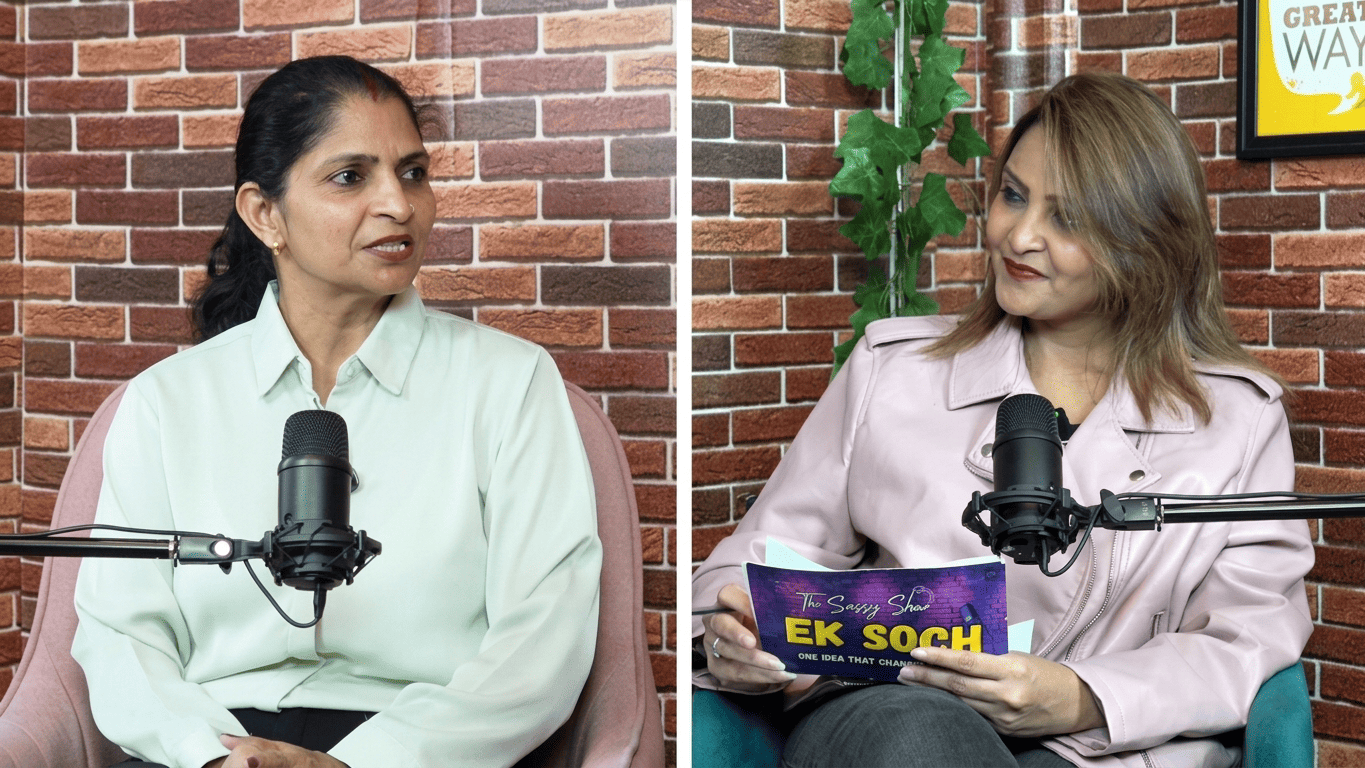
That moment of recognition — the gap between supposed and meant — is where Sushma's journey began. In a recent conversation on the Ek Soch Podcast with host Nirale Pandya, Sushma — founder of Radiance Academy and a former software engineer turned educator — walked through her transition from technology to teaching, what real education actually is versus what Indian schools have reduced it to, why sincere teachers are isolated in the traditional school system, and how a single student's transformation from failed exams to excellence reveals everything about why the system needs to change.
"She was a software engineer. Then she realised that becoming a better human was more important than climbing the career ladder. Now she asks: why do we measure education in marks instead of in humans?"
The Recognition: Lost Between Office and Home
Sushma worked as a software engineer in a stable job with a predictable career trajectory. The position was secure. The income was reliable. By conventional standards, she was succeeding.
Yet in the monotony of this stability, she recognised something had disappeared: herself. The day-to-day routine of office-home-repeat had absorbed her identity. She was executing a life rather than living one. She was competent at what she did, but competence was not the same as purpose.
The recognition that what she was doing was not what she was meant to do became the catalyst for change. This is a recognition that many people have but few act on. Sushma acted.
From Software to Teaching: Why Teaching Chose Her
Sushma's transition to teaching was not based on a childhood dream or on romantic notions about education. It was based on a specific observation.
She realised that only two professions deal with living beings — doctors and teachers. Of these two, teaching uniquely offers a two-way exchange. Doctors treat patients. Teachers exchange with students. Students also teach teachers. The reciprocal nature of the relationship meant that Sushma would not be executing someone else's agenda. She would be co-creating understanding with another person.
That possibility — of mutual transformation rather than one-directional delivery — drew her toward teaching. She left her software engineering job and began her journey as an educator.
Her Guru: Education Is Human Transformation, Not Information Delivery
Sushma's foundational understanding of education came from a mentor named Mr. Prabhakara Reddy.
He taught her a simple distinction that changed how she approached students: education is not information transformation. Education is human transformation. The goal is not to transfer knowledge from teacher to student. The goal is to help a student become a better human.
This distinction is profound. Most schools operate on the information transformation model: we deliver content, students memorise it, students regurgitate it in exams. The transaction is complete. The student leaves with information.
The human transformation model operates differently: the teacher connects with the student beyond content. The relationship deepens. Students feel safe enough to share things with teachers that they would not share even at home. In this space of trust and genuine connection, transformation becomes possible.
Mr. Prabhakara Reddy showed Sushma that this was not a soft skill. It was the entire point of education.
Radiance Academy: Starting Small, Building Independence
Sushma founded Radiance Academy in October 2016 with very few students.
The decision to start her own school was driven partly by the desire to actualise her vision of what education could be, and partly by the recognition that financial independence was essential for women to make their own decisions. If she remained dependent on an employer or on her family, her choices would remain constrained.
Radiance Academy gave her both: a platform to build education the way she believed it should be built, and the financial and personal independence to maintain that vision without compromise. The school became her vehicle for both impact and freedom.
The Gap: What Schools Don't Teach
Sushma identified a fundamental gap by simply observing children's own conversations.
A girl mentioned cooking as "women's work." A boy missed class because he could not sew a button and was ashamed. These were not failures of the formal curriculum. They were failures of what nobody was teaching: basic survival skills and freedom from gender stereotypes.
COVID made this gap obvious to everyone. When people were isolated at home, the absence of self-reliance became critical. People could not cook. People could not clean. People could not manage basic tasks because they had never learned them. COVID revealed that the education system had optimised for exam performance while neglecting the skills that actual living requires.
Sushma's response was to ensure that Radiance Academy taught value-based education alongside academic content. Life skills were not separate curriculum items. They emerged organically in every interaction, because the goal was always human transformation, not information delivery.
The Bitter Truth: Sincere Teachers Are Isolated
Sushma addresses a reality that most people outside the system do not see: sincere teachers in traditional schools are often isolated and monitored excessively.
A teacher who genuinely cares about student welfare and who makes decisions based on what is best for students, rather than on what pleases management, is treated as a threat to institutional control. They are put into "isolation mode." Their autonomy is stripped. Their decision-making power is removed.
The CCTVs installed in schools ostensibly monitor student behaviour. But Sushma observes that they function primarily to watch teachers, not students. The surveillance is designed to ensure compliance, not to protect children.
This environment drives away the teachers who are most needed — the sincere ones who are willing to invest emotional labour and to think creatively about how to reach students. What remains are teachers who survive by understanding the game: flattery of management, compliance with rules, and performance of teaching rather than actual teaching.
Skilled Teachers Flee, Flattery Remains
Sushma makes an observation about why sincere, skilled teachers avoid traditional school jobs: the salary is low and the environment is toxic.
Skilled, qualified teachers have options. They can work in private institutions, they can tutor independently, they can move to other fields. They choose not to work in government or traditional schools because the compensation and the autonomy do not justify the frustration.
Those who remain in the system are often those without better options. And within that group, the ones who advance are rarely the sincere ones. The ones who advance are the ones who master the art of flattery — who understand how to butter the management, how to say the right things in meetings, how to navigate the politics of institutional power.
Sushma's observation is brutal: sincere teachers never flatter management. Those who flatter are never truly sincere. The system selects for flattery and against sincerity.
Parents' Fear and the Cycle of Silence
Sushma identifies a factor that perpetuates the system: parental fear.
Parents worry that if they speak up against a teacher or a school, it will hurt their child. This fear is often justified — children can be subject to subtle retaliation if their parents challenge authority. So parents remain silent, even when they observe problems.
But this silence reinforces the system. Teachers and schools continue behaviour that goes unchallenged because parents are too afraid to challenge it. The problem is framed as conflict, as power struggle, rather than as collaborative problem-solving.
Sushma argues that both parents and schools need a different frame: approaching concerns as problems to solve together, not as battles to win. When parents and schools see each other as adversaries, students lose.
Marks Anxiety: The Pressure Comes From Parents
Approximately 70 percent of Indian students face significant anxiety around marks and rankings. But Sushma's observation is that this pressure comes primarily from parents and constant comparisons, not from children themselves. Children want to learn and to play. Parents want high marks.
Her prescription is specific: compete only with yourself. If a student scored 70 today, the goal is to score 75 next time. Do not race someone else. Do not compare your child to someone with a different capacity, different support system, different resources. That comparison is not motivating. It is demoralising.
The shift from external comparison to internal improvement is not just about reducing anxiety. It is about building genuine competence and confidence. A student who is improving against their own baseline develops real capability. A student who is trying to match someone else's score is either falsely boosted or perpetually discouraged.
Exams as Feedback, Not as Judgment
When students come to her broken after failing an exam, her first job is not to analyse the failure. Her first job is to stabilise them emotionally. Only after they are emotionally safe does she investigate what went wrong: Was it preparation? Was it time management? Was it evaluation anxiety — did they know the content but freeze during the exam?
The emotional stability is what drives better scores, not the content analysis alone. A student who understands their failure and is therefore even more discouraged will perform worse next time. A student who understands their failure and feels supported will perform better.
This is why confidence is the actual driver of performance. A student who believes they can improve will invest the effort to improve. A student who believes they are incapable will not.
Radiance Academy: Concept-Based Learning
Traditional learning focuses on formulas to memorise, procedures to memorise, facts to memorise. Students learn that if you see this type of problem, you apply this procedure. But they do not understand why the procedure works or what the underlying logic is.
Radiance Academy focuses on concepts. Why does the formula work? What problem was the formula designed to solve? What assumptions underlie it? When students understand the concept, they do not need to memorise the formula. They can derive it if they forget it. They can apply it to new situations because they understand the logic, not just the procedure.
This approach is especially powerful in mathematics, which most students fear precisely because they have learned it as mysterious formulas rather than as logic. When the logic becomes clear, the fear disappears.
Sushma also never differentiates between "ranker" students and "average" students. All students are treated as capable of understanding deeply. The difference is not in capacity. The difference is in time and in how the material is presented.
The Transformation: From Failed Exams to Excellence
A student came to her having failed his 9th grade supplementary exams three times. He arrived with zero confidence. He had internalised the message that he was incapable. He was preparing to repeat the year.
Sushma worked with him on two fronts: emotional support and disciplined scheduling. She stabilised his confidence and helped him develop a structured approach to learning. She taught him concepts rather than formulas.
In 10th grade, he scored above 80 percent. His parents cried seeing the result. Not because the marks themselves were exceptional, but because they revealed that the problem was never their child's capability. The problem was that the system had failed to teach him in a way he could understand.
He continues to excel in college today. The student who was marked as incapable became a strong performer when given the proper conditions.
Life Skills: Taught Daily, Not as Curriculum
Life skills at Radiance Academy are not taught as a separate subject with a separate curriculum.
Life skills emerge organically in every conversation and interaction. When a conflict arises between students, it becomes a lesson in conflict resolution. When a student struggles with anxiety, it becomes a lesson in emotional regulation. When a student makes a choice that creates consequences, it becomes a lesson in decision-making.
Every interaction carries a value lesson because the goal of education is human transformation, not information delivery. The vehicle for transformation is the relationship and the conversation, not the textbook.
Breaking Gender Stereotypes: Emotions Are Not Gendered
When a boy was mocked by peers for being "sad like a girl," Sushma addressed it not by comforting the mocked boy but by challenging the entire class. Why is sadness gendered? Why is crying gendered? Why is emotional expression associated with weakness in boys?
Emotional intelligence matters regardless of gender. The ability to recognise and express emotions is not a weakness. It is a strength. Yet boys are systematically discouraged from developing this capacity.
Sushma notes that mothers themselves often reinforce this messaging from childhood, telling boys not to cry, to "be strong," to not express vulnerability. The gender stereotypes are not imposed by schools alone. They are reinforced in homes.
Value Education and the 2047 Vision
Sushma connects individual transformation to national vision.
India's demographic advantage — a young population — is wasted if that youth lacks values and life skills. An educated workforce that is immoral, that is emotionally stunted, that lacks basic human skills, creates a nation of educated incompetence.
The 2047 vision of a developed India cannot be achieved through rote-learned facts and high marks. It requires humans who are thoughtful, ethical, emotionally intelligent, and capable of genuine problem-solving. This requires education to shift from information delivery to human transformation.
This shift will not happen unless rote learning is deprioritised and value-based education becomes a government priority.
One Demand for the Minister of Education
When asked what single change she would make to Indian education, Sushma's answer is direct: pay teachers better.
Better salaries will attract skilled, genuine teachers into the system. Right now, the talented teachers avoid government schools because the pay is insufficient and the environment is toxic. Only those without other options remain.
If teachers were paid competitively, schools could attract and retain the best educators. The cycle of unskilled, flattering teachers continuing because no one better is available would break.
This single change — increasing teacher compensation — would create the conditions for everything else to improve.
Watch the Full Episode
The complete conversation with Sushma covers her journey from software engineer to educator, her core belief in human transformation over information delivery, the gap between what schools teach and what students need, sincere teachers isolated in traditional systems, parental fear perpetuating silence, the epidemic of marks anxiety, exams as feedback, concept-based learning at Radiance Academy, the student transformation case story, life skills taught daily, breaking gender stereotypes, value education and the 2047 vision, and her single demand for education policy.
Nirale Pandya
Entrepreneur | Podcaster
"I help businesses grow through strategic PR, Branding, Business Consultation, Social Media Management, Digital Marketing, and Podcasting."
📅 Book a One-to-One Business Consultation:
Schedule Your Session🔗 Connect With Me