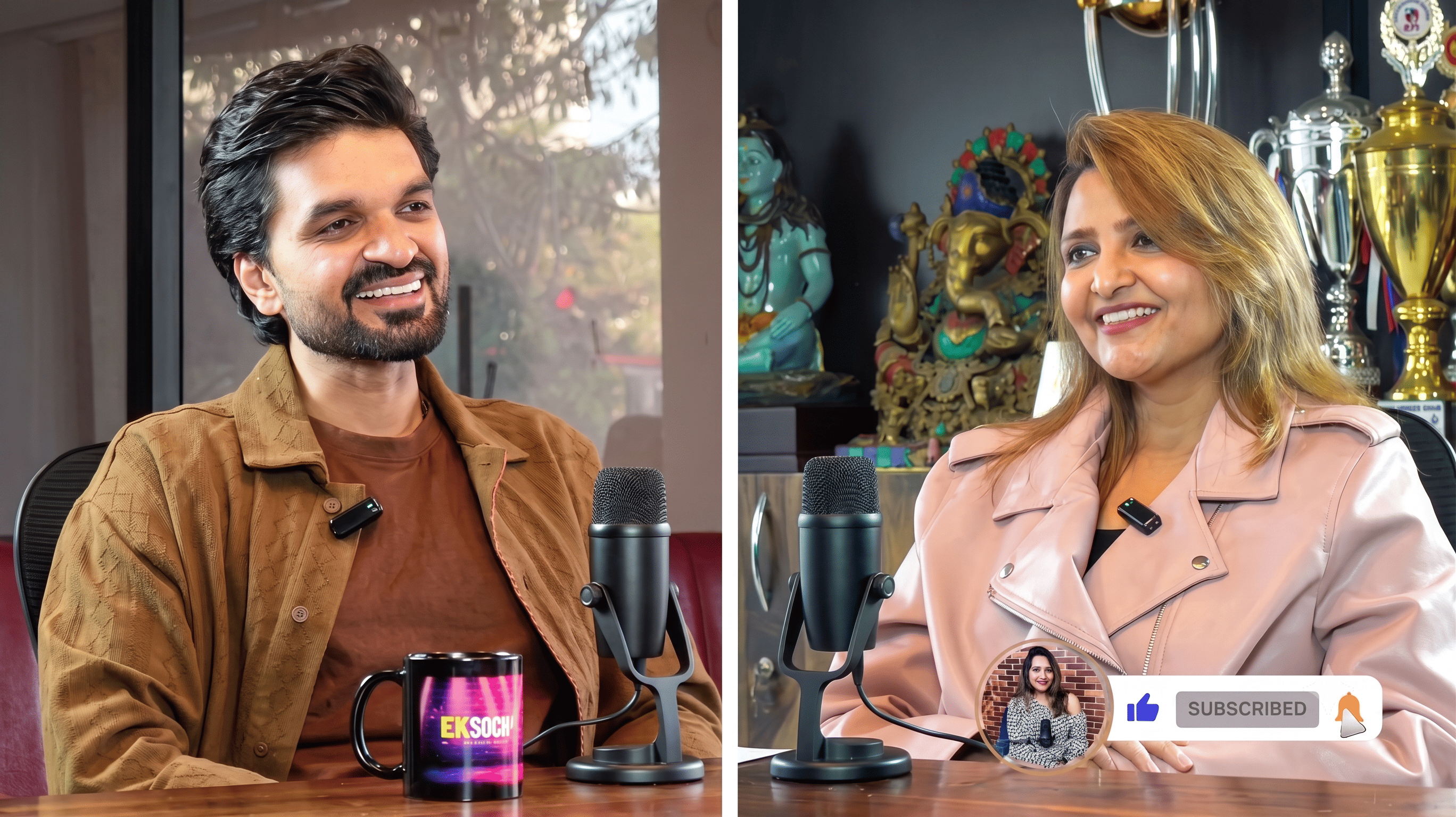
Mumbai: Most people who move to Mumbai to become actors last between one and three years. When the rejections mount, when the money runs out, when the audition calls stop coming, they return to their hometowns, their engineering degrees, their software jobs. They tell themselves it was a nice dream but not realistic.
Deep held the same dream for fifteen years. Not because he had exceptional talent or connections. Not because he came from a film industry family. But because he had one thing that is rarer than talent: the refusal to let go of an idea even when every practical circumstance told him to.
In a recent conversation on the Ek Soch Podcast with host Nirale Pandya, Deep — an actor whose fifteen-year journey culminated in a film backed by Dharma Productions — walked through what sustained him through 2,500 auditions and rejections, why he learned yoga and taught it while auditioning, what his father's silence actually meant, and how a single argument with his father became the foundation of a film about the relationship between fathers and sons that nobody talks about.
"He had one idea: 'I want to be an actor.' No plan. No backup. Just that. For fifteen years, he held that thought while everyone else told him it was impossible."
One Idea, No Roadmap
Deep's entry into his dream was not planned. It was elemental.
When asked what drove him, his answer is disarmingly simple: "I want to be an actor." Not "I want to be famous." Not "I want to be rich." Not "I want to be in films." Just: "I want to be an actor."
The specificity of that clarity is unusual. Most people want to achieve something — success, wealth, recognition — and they choose a path that might lead there. Deep wanted the path itself. The path was acting, and he did not have a secondary goal that the path was supposed to lead toward. The path was the entire point.
This single, uncomplicated certainty became his anchor through fifteen years of rejection and struggle. When everything else pushed him toward quitting, this one idea held.
The SRK Effect and the Shifted Dream
Deep's first dream was not acting. It was aviation.
He wanted to be a pilot. The reason was specific: he saw Shah Rukh Khan in a pilot's uniform in the film Veer-Zaara, and the image created the aspiration. A pilot was what he wanted to be.
But then a realisation shifted the entire trajectory. Actors can play pilots. If he wanted to play a pilot — to inhabit the role, to be the character rather than simply wearing the uniform in real life — he needed to be an actor. The dream transformed. The new dream was not aviation. It was acting.
This is a small shift but it reveals something about how his mind works: he was drawn not to the status or the career but to the imagination. An actor gets to be many things. A pilot gets to be one thing. The dream moved toward possibility rather than toward certainty.
The 2BHK and Seven Friends
Deep credits two anchor systems with making fifteen years of struggle possible: his family and his friends.
His family was his bedrock, but the immediate, daily support came from seven friends who lived with him in a single 2BHK apartment in Andheri. These were people who came to Mumbai for NMIMS degrees, but they stayed — not for the degrees, but as his closest anchors through the rejection and struggle.
The lived reality of shared space, of people who understood the dream intimately because they were living alongside it, created conditions where it was possible to sustain struggle that would otherwise feel isolating. He was not alone in a room waiting for auditions. He was part of a household of people who understood what they were all trying to do.
This practical support — shared rent, shared meals, shared witness to the everyday work of chasing a dream — is often overlooked in stories about individual achievement. But for Deep, it was foundational.
His Father's Love With No Vocabulary
Deep's father is a yoga teacher — a man grounded in practice, discipline, and spiritual perspective rather than in ambition or material success.
The father never explicitly blocked the dream. But he was also not a cheerleader. Instead, he framed the reality with clarity: "If I didn't stop you, it doesn't mean you'll become Shah Rukh Khan — figure it out."
That single line, born from a conversation between father and son, became so important that Deep put it directly into the film. His father's refusal to either endorse or block, combined with his insistence that the son understand the actual difficulty of what he was attempting, created a framework where the dream was the son's responsibility, not the father's blessing.
Deep interprets this as a form of love — love that does not pretend the path is easy, love that does not enable false expectations, love that says "I trust you to know what you are doing and to live with the consequences." It is love with no vocabulary of encouragement, but it is love nonetheless.
Never Be a Financial Burden
Deep identifies something he considers non-negotiable for anyone pursuing an uncertain dream: financial self-sufficiency.
He taught yoga from age seventeen. When he moved to Mumbai, he continued teaching yoga, earning 25,000 to 30,000 per month. This income came from his own work. He never asked his middle-class father for money to support his dream.
This choice had multiple effects. First, it meant he could sustain fifteen years of auditions and rejections without his family facing financial strain. Second, it preserved his agency — he was not beholden to anyone else's opinion about whether the dream was worth pursuing. Third, it created discipline: the yoga teaching gave him a reason to wake up, to engage in work, to maintain some structure beyond the audition waiting.
His advice to aspiring actors is unambiguous: do not come to Mumbai without a parallel skill that pays your bills. Do not be a financial burden on your middle-class parents while you chase an uncertain dream. The dream can be pursued, but not at the cost of your family's stability.
Surviving 2,500 Auditions Without Counting
When asked how he survived so many rejections, Deep offers a metaphor that illustrates his entire approach.
There is only one road from Mumbai to Ahmedabad. Some people walk. Some drive. But the road is the same. The only way out is through.
He stopped counting auditions at 2,000 because counting began to feel depressing. Each number seemed to reinforce failure rather than to mark progress. So he stopped. He simply continued showing up, auditioning, being rejected, and then showing up again.
This is not optimism in the sense of believing rejection will not hurt. It is stoicism in the sense of accepting rejection as the texture of the road rather than as evidence that the road is wrong.
The First Break: Krishnaben Khakhrawala and Ajab Gazab Love
After years of auditions, Deep's first on-screen role came in the Gujarati television series Krishnaben Khakhrawala in 2011.
It was not a lead role. It was not a significant role. But it was proof that he could be on screen, that the work would be visible, that the fifteen years of auditions had produced something tangible.
This was followed by a five-line role in the film Ajab Gazab Love in 2012. The film itself was not significant, but the role meant that his face appeared on screen in a theatrical film. The trailer for Ajab Gazab Love was attached to Ek Tha Tiger — which meant that Deep's five lines were shown in theatres across the country before a major Bollywood film.
These were small breaks. But they broke the pattern of invisible auditions. They created proof that progress was happening.
Anupam Kher's Actor Prepares: Teacher and Student
Deep's formal training in acting came through an unlikely route: teaching yoga while simultaneously being a student.
In 2009, a yoga client mentioned Anupam Kher's acting school, Actor Prepares, which was based in Ahmedabad. Deep was hired as a yoga teacher at the school. But he was also a student. His mornings were spent teaching yoga to acting students. His days were spent as an acting student himself.
This gave him access to structured training and to Anupam Kher's mentorship while maintaining financial stability through the yoga teaching work. Later, he taught yoga to Sanjay Gadhvi, the director of Dhoom, and through him, to David Dhawan. These connections, again rooted in his yoga work, created visibility in a network he might not otherwise have accessed.
Cinema as Study, Not Entertainment
Deep identifies a habit that distinguishes him from most aspiring actors: he watches every film that releases, in every language.
His framing is clear: a designer studies design. A podcaster studies podcasts. An actor must study cinema relentlessly. You cannot understand the craft without consuming the medium at the level of detail that only repeated viewing provides.
But he emphasises that this is not casual consumption. He refuses to watch films on phones. He goes to dark theatres with proper sound. He watches with the attention that a craftsman gives to studying their craft rather than the divided attention that entertainment implies.
This disciplined consumption of cinema — which requires both time and commitment — is part of what sustained him. It kept cinema as the central focus of his life, not as a side interest.
Writing as the Bridge Between Auditions
Deep's journey from actor to writer was not strategic. It emerged from idle time between auditions.
He read about Sylvester Stallone writing Rocky, which inspired him to try writing. His first piece was a contrarian article arguing that Indian society is not yet ready for a completely corruption-free system — a piece that reflects philosophical thinking rather than career calculation.
Writing became a way to think through ideas while waiting for auditions, to stay intellectually engaged, and to create something independent of whether auditions came through. The act of writing became its own form of acting preparation — each required understanding human motivation, conflict, and resolution.
The Film's Origin: A Question About Fathers
The idea for the film Zindagi Mein Tsuna came from a moment of tension between Deep and his father.
In 2016, during an argument-turned-banter, Deep blurted out to his father: "What do you even know?" He immediately paused, recognising the harshness of the question. But the question sat with him.
It became the film's central question: Do we actually know our fathers before they became fathers? Who were they as people — with their own dreams, fears, desires — before they became the figure of authority or absence or struggle that their children experience?
This question, born from genuine conflict with his own father, became the emotional core of his storytelling. The film is not about a perfect father-son relationship. It is about the mutual misunderstanding and unspoken love that characterises many father-son bonds.
The Father-Son Bond: The Relationship Nobody Names
Deep makes a specific observation that has shaped his writing: the father-son relationship carries more emotional complexity than any other relationship, yet it is rarely explored.
Mother-son relationships have been extensively dramatised — the protective mother, the dependent son, the conflicted adult. Brother relationships have clear dynamics. But the father-son bond, loaded with unspoken love, with expectation, with silence, with misread intentions, has been left largely unnamed in cinema and in conversation.
His father, who rarely offered explicit emotional expression, created a space where love existed but was not articulated. Understanding that love — recognising it in the silence and the refusal to either enable false hopes or crush genuine dreams — became the emotional journey of Deep's own life and now of his filmmaking.
Dharma Productions: Proof on His Father's Birthday
The moment when Dharma Productions came on board was not a private negotiation followed by a public announcement. It was a public tag, a notification on his phone.
On May 20th — his father's birthday — at 5 PM, Dharma Productions tagged him in the announcement post. He got the notification, saw it, and cried for half an hour.
The emotion was not "I made it" in the sense of having achieved fame or success. It was that fifteen years of belief in an idea with no evidence finally had proof. The idea was real. The work was real. The dream was not fantasy. It was something tangible enough that a major film production company was backing it.
The timing — on his father's birthday — carried its own significance. The father who had never blocked the dream but had never promised it would happen, finally, through this coincidence of dates, witnessed the proof that it had.
The Dialogue from Real Life
The film includes a specific line that his real father actually spoke to him. Deep did not rewrite it. He did not improve it. He put it directly into the script unchanged.
This line, born from the actual lived relationship between a father and son, carries the weight of real conversation. It is not dialogue imagined by a screenwriter. It is dialogue lived by a person, and then recognised as so important that it needed to be preserved exactly as spoken.
Nirale Pandya
Entrepreneur | Podcaster
"I help businesses grow through strategic PR, Branding, Business Consultation, Social Media Management, Digital Marketing, and Podcasting."
📅 Book a One-to-One Business Consultation:
Schedule Your Session🔗 Connect With Me