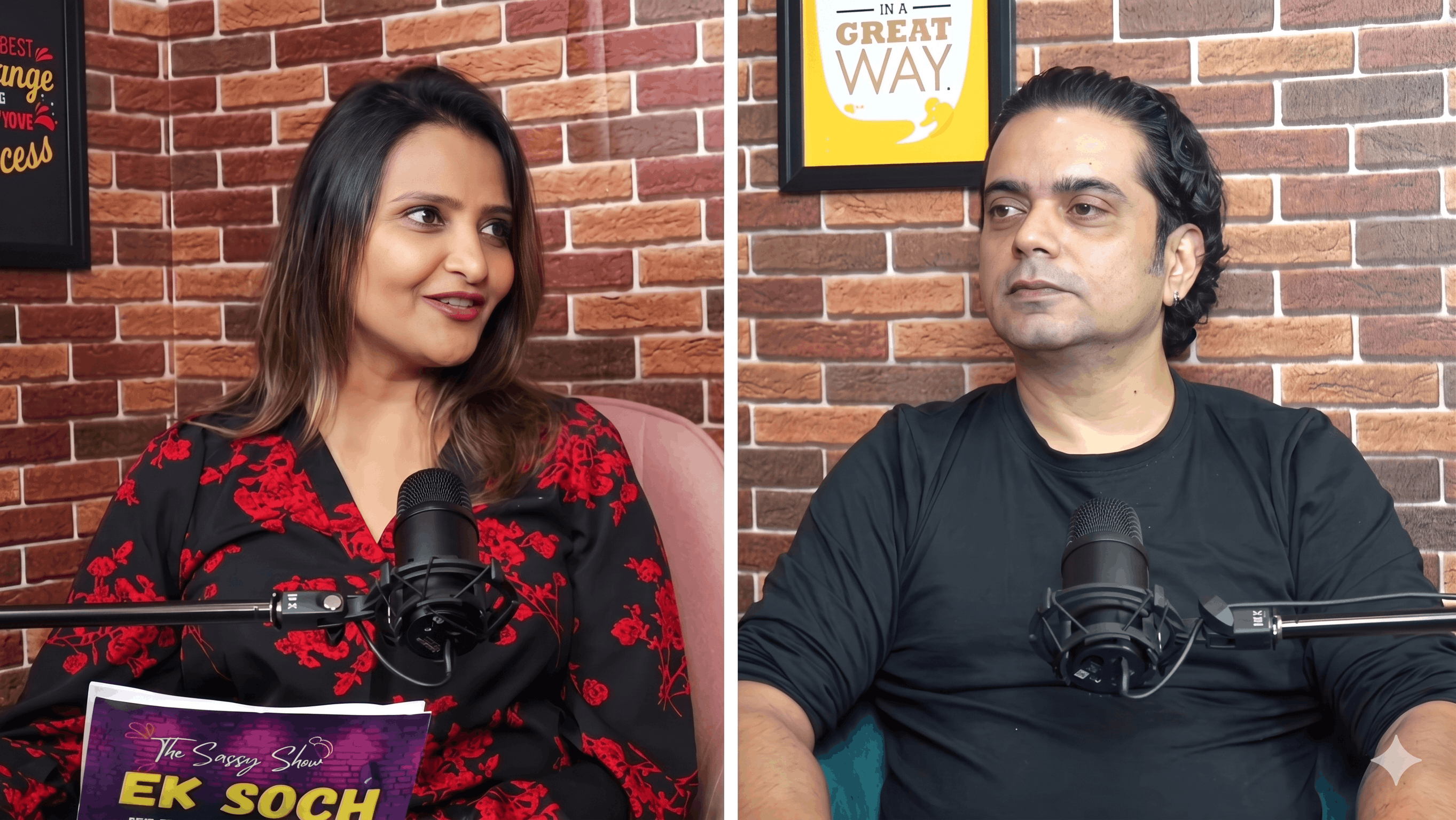
Mumbai: Most cosmetic brand founders either have family wealth, investor backing, or both. Bharat Jagtiani has neither. He has something more useful: seventeen years of industry experience built through failure, a wife who mortgaged her gold jewelry, and the willingness to work for years without profit while building something that would eventually serve thousands.
In a recent conversation on the Ek Soch Podcast with host Nirale Pandya, Bharat — founder of Hairmac and Medicosmo Formulations, a platform that has helped hundreds of entrepreneurs launch their own cosmetic brands with minimal capital — traced his journey from a stabbing victim fired from his job, to building a ₹25 crore self-funded company, to creating infrastructure that makes entrepreneurship accessible to people with ₹30,000 and a belief.
"He was stabbed, went into a coma, and was fired. His wife mortgaged her jewelry for ₹50,000. Today he helps founders launch brands with what most people spend on rent."
The First Failure: eBay Hair Oil Sales
Bharat Jagtiani's entrepreneurial journey began in 2008 with herbal hair oil sold online at a time when eBay was the primary platform available. The effort produced almost no sales. He received a thirty-day notice and faced the immediate reality that online sales alone, without volume channels, could not sustain a business.
The pivot came from his wife, who ran a small salon in Kharghar. She suggested selling three pieces at the salon — a test that returned not only immediate sale but a reorder within two days. The insight was direct: offline, in physical spaces where customers actually were, volume was possible. Online alone was not.
He shifted his entire strategy toward field and offline salon sales. Within months, he was moving three hundred pieces monthly. Within a year, three thousand. The channel that most people now consider outdated or secondary was, in his case, the only channel that actually worked.
The Moment That Forced Transformation
The trajectory changed violently in 2010. While on field work in Bandra, Bharat was stabbed by a mentally ill person. The stabbing was severe enough to put him in a coma for several days. When he recovered and returned to his job after three months of hospitalisation, he was fired.
The dismissal was harsh but clarifying. His father's advice was direct: work for yourself. His wife's response was to mortgage her gold jewelry to raise ₹50,000 — an act that carried emotional weight far beyond the financial amount. It was a statement that she believed in him at a moment when employment had rejected him and his own confidence was shattered.
That ₹50,000 became the foundation of everything that followed.
The First Brand Fails — Learning Fees
The first brand — Hair Vital — failed. Capital that was supposed to carry the business through the crucial early phase ran out. Bharat had to make impossible choices: pay the factory, fund household expenses, or invest in field sales. He could not do all three. The business collapsed.
Bharat frames this not as tragedy but as what he calls a learning fee — mandatory tuition that every entrepreneur must pay, in any industry, any country. The fee buys education that cannot be purchased any other way. He paid it with his own capital and his own time. Most entrepreneurs never pay it, which is why they never learn.
How Long It Actually Takes
Bharat's critique of entrepreneurship culture is direct: the expectation of rapid success — building a five hundred crore brand and exiting quickly — is setting most founders up for failure.
His own experience and the hundreds of founders he now works with show a consistent pattern: without one hundred percent commitment and consistency for at least three years, success is unlikely. The three years are not optional. They are the time required for the market to understand what you are building, for the product to prove itself, for the distribution channels to establish, and for the business to move from idea to sustainable operation.
The founders who expect quick results have already lost, because the moment they face the inevitable difficulty of year two, they retreat. The founders who succeed are the ones who have decided, at the beginning, that three years is the minimum commitment they are willing to make.
The Unspoken Cost: Family Sacrifice
Bharat is explicit about something that most entrepreneurship narratives romanticise or ignore: entrepreneurship is not a solo sacrifice. It is the entire family's sacrifice.
His wife's willingness to mortgage her jewelry, to support him while he worked without income, to believe when employment had rejected him — this was not support in the abstract. It was specific, ongoing, and costly. The family lived with reduced expenses, limited security, and the genuine anxiety of a business that could fail.
He credits his wife and family support as the actual foundation of his survival through the hardest years. He argues that every founder needs at least one person who genuinely believes in them, not because they are being supportive, but because they have seen something real in the founder's commitment and capability.
Hairmac Born from Experience, Not Just Capital
When Hairmac was launched with fresh capital, it was not a fresh start. It was the launch of someone who had already learned seventeen years of lessons, who had internalized the failures, and who was finally applying that accumulated knowledge to a business with enough capital to actually execute.
A friend from Africa invested ₹1 lakh. Combined with Bharat's experience, the capital became enough to actually launch with a plan rather than with hope. The brand that followed was not lucky. It was the output of someone who had learned, through failure and resilience, what actually worked.
Medicosmo: Solving the MOQ Problem
The second business — Medicosmo Formulations — was born from observing a barrier that keeps most potential founders out of the cosmetic industry: the minimum order quantity. Factories require massive orders — thousands of units — before they will manufacture. This requires capital that most founders do not have.
Medicosmo solved this by offering entrepreneurs the ability to launch with as little as ₹30,000 to ₹40,000 — enough for one or two SKUs with full support: formulation, packaging design, bottle procurement, label design, and distribution guidance.
The insight was direct: the barrier was not that founders lacked the idea or the capability. The barrier was capital. Remove the capital barrier and the market would unlock. Medicosmo has now helped hundreds of founders launch their own brands.
The Offline Channel That Most Brands Ignore
Bharat's consistent argument throughout the conversation concerns offline retail — specifically salons — as an underestimated and massively underutilised channel.
Salons are enormous distribution points. Customers visit regularly. They trust their stylist's recommendations. New brands appear constantly in salons. The L'Oréal monopoly that once dominated salon shelves is breaking up as customers explore alternatives. Yet most cosmetic brands focus entirely on online, chasing what feels like scale but produces limited volume.
For small brands, offline salon distribution generates ten times the volume of online. The economics are different. The relationships are different. The customer loyalty is different. The brands that ignore this channel in favour of digital-only strategies are leaving their largest volume opportunity untapped.
What's Killing Salon Businesses
Bharat identifies a crisis in the salon industry that has received almost no public attention: unethical price competition has destroyed the economics of salon services.
Keratin treatments that once commanded ₹8,000 or more are now available for ₹500 in competing salons. The race to the bottom has eliminated the profit margin that allowed salons to retain quality staff, invest in equipment, and deliver consistent service. The salon owners have unified neither as an industry nor as a community, so there is no mechanism to standardize pricing or resist the downward pressure.
The result is that salon workers are increasingly underpaid, salon businesses are increasingly unprofitable, and the customer experience is increasingly degraded. The solution Bharat sees is collective action — a salon community that agrees on standards and resists the pressure to compete on price alone.
White Labeling for Salon Loyalty
One of Medicosmo's most interesting offerings is helping salons create their own branded products — shampoos, conditioners, serums — manufactured by Medicosmo but branded for the specific salon.
The outcome solves two problems simultaneously. The salon customer must return to that specific salon to repurchase the products they have used. The stylist's effort — the relationship built during the service — now generates recurring revenue for the salon rather than for an external brand. The salon transforms from a service business into a service plus product business, with genuine customer retention.
Manufacturing Expertise as Competitive Advantage
Bharat's advantage in the cosmetic manufacturing space is not that he has access to different factories or better equipment. It is that he brings seventeen years of industry knowledge that most manufacturers do not offer.
Most factories make the product and hand it over. They provide no guidance beyond that. Medicosmo differentiates by bringing understanding of distribution networks, retailer relationships, regulatory compliance, market positioning, and the specific details that separate a product launch that works from one that fails.
The value is not in the manufacturing. It is in the ecosystem of knowledge that surrounds the manufacturing.
The Product That Cannot Be Rushed: Stability Testing
Bharat addresses a step that most startup founders want to skip because it slows their path to market: stability testing.
Before any product can responsibly launch, it must pass stability testing — six to eight months of testing across different temperature and humidity conditions to ensure the product does not separate, change colour, or degrade over time. The testing is not optional or negotiable. It is the difference between launching something that works and launching something that fails in customers' bathrooms after three months.
He points out that AI can assist in formulation, but it cannot predict the physical stability issues that only real-world testing across different conditions can reveal. The founder who tries to skip this step or compress it will fail in the market. The founder who treats it as mandatory will succeed.
Regulatory Compliance: Where Small Mistakes Cost Everything
Bharat emphasises a detail that many founders overlook: regulatory compliance in cosmetic labelling. A missing rupee symbol on the MRP. The absence of "inclusive of all taxes." A batch number that does not meet specifications.
Any of these can result in fines that exceed the entire business setup cost. The regulatory environment is not harsh arbitrarily — it exists to protect consumers. But the founder who treats it as optional will be destroyed by it.
The Question Every Founder Should Ask Themselves
Bharat's most direct advice to aspiring cosmetic brand founders is a single question: would you buy this product at this price?
If the answer is no — if the founder is building something they would not personally purchase — then no one else will either. The first sale might be generated by advertising or by a salesperson's skill. The second sale is generated only by the product itself. If the product is not something the founder would repeat-buy, the business will fail after the first cohort of customers.
Eight Years, Zero Loans, Zero Investors
Hairmac reached ₹25 crore in turnover over eight years without bank loans, without investors, without credit cards — entirely self-funded and bootstrapped from the early ₹50,000 his wife raised.
Bharat frames this not as evidence of his exceptional capability but as a testament to building with integrity and what he calls karma in work. His formulation is direct: work is karmic. Take one step toward your work, and your work will take ten steps toward you.
Nirale Pandya
Entrepreneur | Podcaster
"I help businesses grow through strategic PR, Branding, Business Consultation, Social Media Management, Digital Marketing, and Podcasting."
📅 Book a One-to-One Business Consultation:
Schedule Your Session🔗 Connect With Me