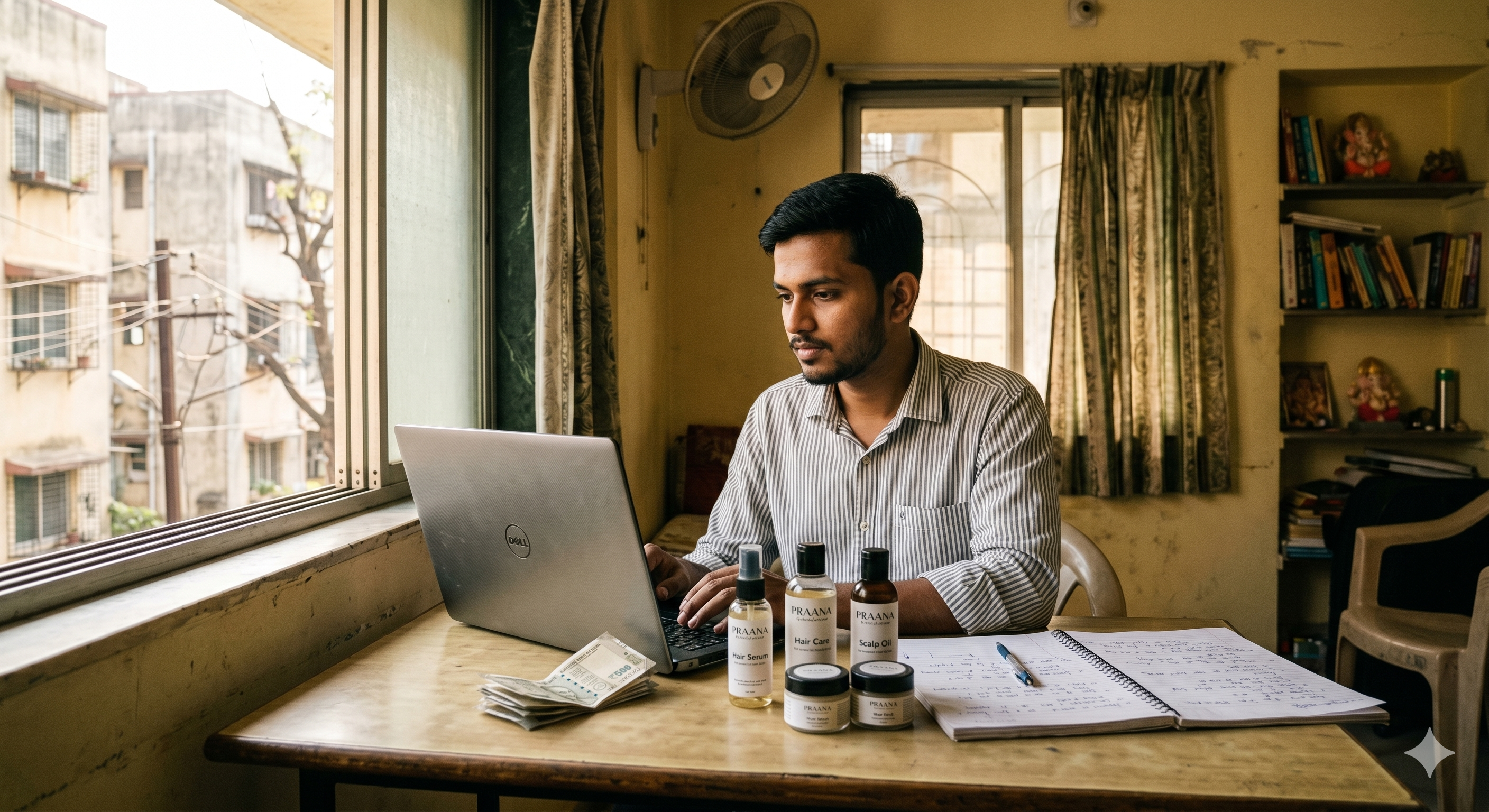
Most people are waiting for the right time, the right amount, or the right idea.
Meanwhile, someone in a Navi Mumbai chawl mortgaged their wife's gold jewelry for ₹50,000 and built a ₹25 crore company from it. Someone else in Nashik learned dance from YouTube tutorials and bootstrapped an app that now serves thousands. A gym founder in Mumbai started with one batch of clients and no business degree.
The money was never the real barrier. The belief was.
Here's the truth: ₹50,000 is enough to start something real in India in 2026. Not enough to go big immediately — but enough to start, test, learn, and build forward.
Why ₹50,000 Is More Than You Think
India has one structural advantage that most Western startup guides ignore: low operational cost.
- You can register a business for under ₹2,000
- A basic website costs ₹3,000–₹5,000 (or free with the right tools)
- Social media marketing costs ₹0 at the start
- Physical distribution through salons, local shops, and WhatsApp groups costs almost nothing
- India's factory and supplier ecosystem allows manufacturing at quantities that would be impossible in Europe or the US
₹50,000 in India is not seed funding. It's a starting signal. What you do with the first ₹50,000 determines whether you ever need more.
Step 1: Pick a Business That Matches the Capital
Not every business idea is suitable for ₹50,000. The first discipline is choosing something appropriate for the capital you actually have — not the capital you wish you had.
Best fits for under ₹50,000:
- Service businesses — freelancing (web design, content, social media, automation), tutoring, consulting. Zero inventory. Zero manufacturing. Pure skill monetisation. Start today.
- Reselling / dropshipping — source products from Meesho, IndiaMart, or local manufacturers. Sell on WhatsApp, Instagram, or offline. No upfront inventory required with the right supplier.
- Food & home-made products — tiffin services, pickles, baked goods, home-made cosmetics. Low input cost, direct customer relationships, offline-first.
- Cosmetic / personal care brand — platforms like Medicosmo Formulations allow you to launch your own branded product for ₹30,000–₹40,000. Full formulation, packaging, and label. Your brand. Real product.
- Digital products — online courses, templates, Notion dashboards, design assets. Build once, sell infinitely. Near-zero cost after creation.
- Local services — salon, repair, cleaning, photography, event coordination. Skill + tools + WhatsApp = a business.
Avoid at ₹50,000: Manufacturing heavy products, opening a retail shop with inventory, building a complex app from scratch.
Step 2: Validate Before You Spend
The single most expensive mistake early founders make is spending money before validating that anyone wants what they're building.
Before spending ₹1 on inventory, packaging, or a website — sell something first.
- Put up a Google Form or a simple WhatsApp message describing your product or service
- Ask 10 people from your target audience if they would buy it at your target price
- If 3 out of 10 say yes immediately — you have something. If nobody responds with enthusiasm — the idea needs refinement
This costs ₹0 and saves you from burning your entire capital on something the market doesn't want.
The Ek Soch lesson here is direct: Bharat Jagtiani's wife sold three pieces of hair oil at her salon and got a reorder within two days. That reorder — not a business plan, not a pitch deck — was the validation that built a ₹25 crore company.
Find your two-day reorder moment before you scale.
Step 3: Break Your ₹50,000 Into Three Buckets
| Bucket | What It's For | Suggested Amount |
|---|---|---|
| Product / Service Setup | Raw material, first batch, tools, equipment | ₹20,000–₹25,000 |
| Brand & Presence | Logo, basic website, visiting cards, packaging | ₹5,000–₹10,000 |
| Sales & Distribution | Travel, samples, first round of promotion | ₹10,000–₹15,000 |
| Reserve | Emergencies, reorder, unexpected costs | ₹5,000–₹10,000 |
The rule: Never spend the reserve unless the business demands it. Most founders who fail do so because they had no cushion when something unexpected happened — and something always does.
Step 4: Go Offline First
This is the most counterintuitive advice in 2026 — and the most important.
Instagram feels like scale. WhatsApp feels slow. But for small Indian businesses starting with limited capital, offline distribution generates 10x the volume of online in the early stages.
- Salons, medical stores, local kirana shops, offices, apartment buildings, sports clubs — these are physical spaces where people gather, trust already exists, and new products get real chances
- A conversation with a salon owner or a kirana shop owner costs ₹0 and can generate consistent monthly orders
- Your first 100 customers will almost certainly come from people who know you, see you, or were referred by someone who does
Build the offline channel first. Build online after you have proof of product-market fit. This is what Bharat Jagtiani did in 2008. It still works in 2026.
Step 5: Survive Year One. Win in Year Three.
Here's the statistic nobody puts on a motivational poster: most businesses fail because the founder quit, not because the business was unviable.
Year one is learning. You will get things wrong. Your pricing will be off. Your distribution will be inefficient. Your product will need adjustment. This is not failure — it is the process.
Year two is the hardest. Growth feels slow. The initial excitement fades. Other people's success looks faster and easier. This is the year most founders exit.
Year three is where the business becomes real. Distribution is established. Customers are returning. The product has proven itself. Word of mouth starts doing the selling for you.
The founders who commit to three years before evaluating whether to continue are the ones who reach year three. The founders who evaluate after six months rarely do.
The Honest Part: What ₹50,000 Cannot Buy
- Consistency — showing up every day, even when nothing is happening
- Family support — someone who believes in you when the bank account doesn't agree
- Patience — the three-year minimum is not negotiable
- Willingness to sell — the founder who cannot sell their own product will fail regardless of product quality
The capital is the smallest variable. The founder's commitment is the largest.
Starting Today: The ₹0 First Step
Before you spend anything, do this:
- Write down the one problem you can solve better than most people around you
- Identify 10 people who have that problem
- Describe your solution to them — verbally, in person or on WhatsApp
- Ask if they would pay for it
- If yes — take the order before you build the product
That sequence costs ₹0. It is also the sequence that every successful founder in India — from Bharat Jagtiani to Tejas Dhoke to every guest who has ever sat across from Nirale Pandya on Ek Soch — followed in some form.
One step forward. Ten steps back from the universe. Start.